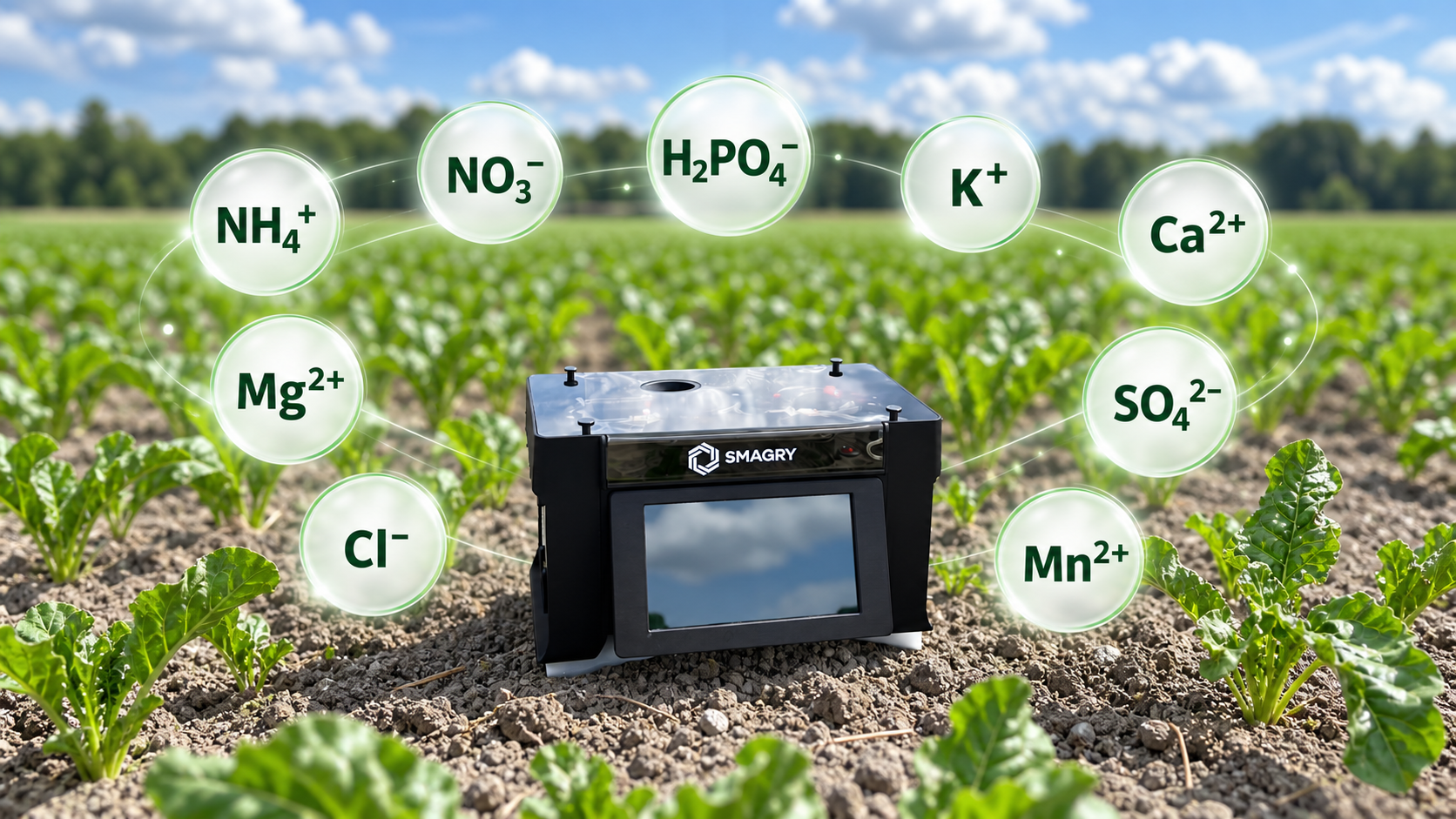
Beyond NPK: The Nine Ions SMAGRY Measures — and What They Tell an Agronomist
A fertilizer plan describes what goes into a field. Understanding crop nutrition also means investigating what happens next: which nutrient forms are present in the soil, how they behave, and what they contribute to plant growth. Nitrogen, phosphorus, and potassium remain central to that conversation, but they cannot explain every nutritional limitation a crop may face.
SMAGRY provides on-site quantitative soil analysis of nine ions: NH₄⁺, NO₃⁻, H₂PO₄⁻, K⁺, Ca²⁺, Mg²⁺, SO₄²⁻, Cl⁻, and Mn²⁺. These represent eight nutrient elements, with nitrogen measured in two different forms. Each adds something distinct to an agronomist’s assessment, from nitrogen mobility and phosphorus nutrition to the elements involved in photosynthesis, tissue development, and water regulation.
Understanding those differences is what turns a set of measurements into useful agronomic information.
What the nine-ion panel adds to soil nutrient analysis
An ion is an atom or group of atoms with an electrical charge. Those small plus and minus signs matter: they help explain why different nutrients behave differently in soil. Ammonium and nitrate both supply nitrogen, for example, but their movement and retention are very different.
The panel also extends the discussion beyond the three nutrients most familiar from fertilizer labels. Calcium, magnesium, and sulfur are essential macronutrients. Chloride and manganese are essential micronutrients, required in smaller quantities but still necessary for normal plant function. Adequate NPK cannot compensate for the absence of another essential nutrient. Together, these measurements give agronomists a broader view of mineral nutrition, although they do not cover every essential element or every aspect of soil health.
University of Florida IFAS explains these nutrient roles and classifications.
NH₄⁺: Ammonium and the less mobile form of mineral nitrogen
Ammonium is a nitrogen form that roots can absorb. It can enter the soil through fertilizers or be released as microorganisms break down organic material. Its positive charge allows it to be retained on negatively charged soil surfaces, making it generally less mobile than nitrate. Under suitable conditions, microorganisms convert ammonium into nitrate through nitrification. Measuring NH₄⁺ therefore helps an agronomist understand the nitrogen forms present at sampling, particularly when considered alongside recent fertilizer applications and soil conditions. It does not represent nitrogen still held in undecomposed organic matter.
See the University of Minnesota’s explanation of nitrogen transformations.
NO₃⁻: Nitrate and nitrogen that moves with water
Nitrate is another major nitrogen source for plants. Unlike ammonium, it is not strongly retained by the negatively charged surfaces common in agricultural soils and can move with drainage water below the rooting zone. Its concentration is therefore particularly relevant when reviewing nitrogen supply alongside rainfall, irrigation, and sampling depth. Reading NO₃⁻ together with NH₄⁺ provides a more informative snapshot than treating mineral nitrogen as one undifferentiated quantity. Repeated measurements can reveal changes, although a decline alone cannot establish whether nitrogen was taken up by crops or lost from the sampled soil.
University of Minnesota Extension describes nitrate movement and loss pathways.
H₂PO₄⁻: Dihydrogen phosphate and phosphorus nutrition
Dihydrogen phosphate is one of the phosphate forms that plants absorb through their roots. Phosphorus is involved in energy transfer through ATP, as well as the structure of DNA and cell membranes. Its role reaches across growth and metabolism, rather than belonging only to one stage of crop development. Measuring H₂PO₄⁻ adds phosphate-specific information to the assessment of phosphorus nutrition; it should not be confused with measuring every form of phosphorus stored in soil.
Penn State explains how plants use phosphate in these essential processes.
For an agronomist, the next question is how the test recovers that phosphate. Extraction chemistry affects the result and its interpretation. We explore this in more detail in our article on rhizosphere simulation and plant-available phosphorus.
K⁺: Potassium and the regulation of water and transport
Potassium helps regulate the opening and closing of stomata—the pores through which leaves exchange gases and lose water. It also activates enzymes and supports the movement of sugars and other substances within the plant. These functions make potassium relevant to crop development and the plant’s response to changing water conditions. Soil can contain substantial potassium within minerals while only a smaller fraction is readily available. For an agronomist, a K⁺ measurement contributes evidence about the potassium recovered by the extraction method, helping assess nutrient supply alongside crop demand. It is useful nutritional information when investigating crop performance, rather than a direct measurement of drought tolerance.
Ca²⁺: Calcium and the development of healthy tissues
Calcium contributes to cell-wall structure, membrane stability, and root development. Its importance becomes especially visible when developing tissues do not receive enough, as in blossom-end rot in tomatoes and peppers. Yet a calcium-related disorder does not necessarily mean that the soil contains too little calcium. Delivery within the plant depends strongly on water movement and the distribution of that flow between tissues. A Ca²⁺ measurement helps an agronomist investigate the supply side of the problem, while irrigation history, root condition, and crop observations help explain whether calcium is reaching the tissues that need it. That distinction can change the management response considerably.
Mg²⁺: Magnesium and the machinery of photosynthesis
Magnesium sits at the centre of the chlorophyll molecule, giving it a direct role in the plant’s ability to capture light. It also activates enzymes involved in normal metabolism. An adequate nitrogen supply cannot substitute for magnesium when magnesium itself is limiting. Measuring Mg²⁺ brings this part of the nutritional picture into view and gives agronomists another line of evidence when investigating poor growth or leaf discolouration. The measurement is particularly worth considering where soil conditions suggest a risk of inadequate supply, such as some acidic, sandy soils. Crop observations and, where appropriate, tissue analysis help establish whether the soil result corresponds to a limitation within the plant.
SO₄²⁻: Sulfate and the sulfur needed for protein formation
Sulfate is the principal form in which roots obtain sulfur from soil. Sulfur is a component of amino acids used to build proteins and is involved in enzymes and other essential compounds. Much of the sulfur stored in soil may be in organic forms that must first be transformed before roots can use it. A sulfate measurement therefore addresses a different question from total sulfur content: how much sulfate does the test recover at the time of sampling? For agronomists, this helps bring sulfur supply into an investigation that might otherwise focus too narrowly on nitrogen. The distinction matters because sulfur deficiency can produce symptoms resembling nitrogen deficiency.
Penn State’s sulfur management guidance explains these nutritional roles and soil transformations.
Cl⁻: Chloride, an essential nutrient that also deserves monitoring
Chloride is sometimes discussed only as an unwanted component of salts, but plants need it for normal function, including photosynthesis. Its inclusion in the panel is a reminder that an essential nutrient can also become problematic when exposure is excessive.
Chloride can enter a growing system through irrigation water and fertilizers such as potassium chloride. Measuring Cl⁻ helps an agronomist investigate those inputs and assess whether chloride accumulation warrants attention for the crop concerned. Sensitivity differs between crops, so the result needs a crop-specific interpretation. Chloride also represents only one part of a salinity assessment; it does not replace an evaluation of total soluble salts.
Mn²⁺: Manganese and the influence of soil conditions
Manganese supports photosynthesis and activates a range of enzyme systems. Plants require relatively small amounts, but an inadequate supply can still restrict growth. Its availability is particularly sensitive to soil conditions: increasing pH can reduce availability, while strongly acidic conditions can make manganese sufficiently available to create a toxicity risk. This makes Mn²⁺ a useful part of a broader diagnostic assessment. An agronomist can consider the measurement alongside separately measured soil pH, liming history, and crop symptoms to investigate whether manganese nutrition deserves closer attention. The aim is adequate supply for the crop, not the highest possible manganese reading.
Reading the nine ions as agronomic evidence
The value of a broader panel is that it helps an agronomist ask more precise questions. A nitrogen result can be examined as ammonium and nitrate. A crop with apparently adequate NPK can still be investigated for magnesium or sulfur limitations. A calcium-related symptom can prompt a closer look at both nutrient supply and water management, while chloride and manganese results can highlight situations where excess deserves attention as well as deficiency.
Getting useful answers starts with a representative sample and consistent preparation. SMAGRY measures selected ions in a prepared soil extract; those concentrations are not a complete inventory of the soil’s nutrient reserves or a direct measurement of what the plant has absorbed. Comparisons should account for sampling depth, timing, handling, extraction method, and reporting units. Fertilizer decisions also need interpretation appropriate to the method, crop, and local conditions: thresholds developed for one soil test should not simply be transferred to another.
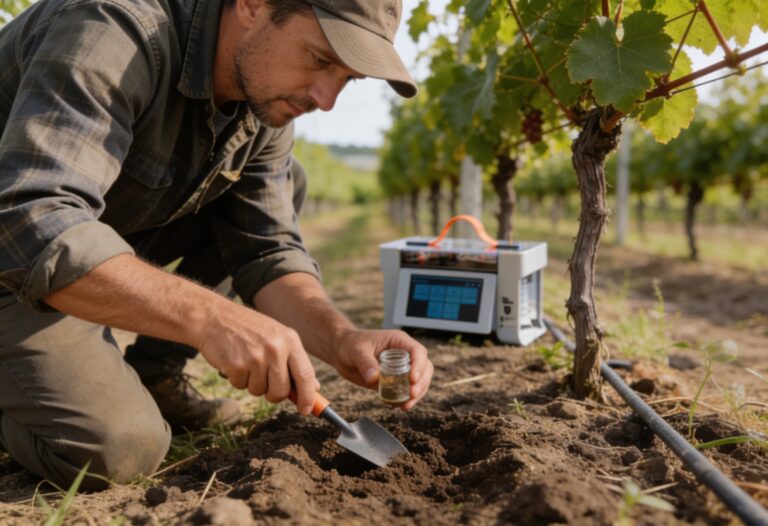
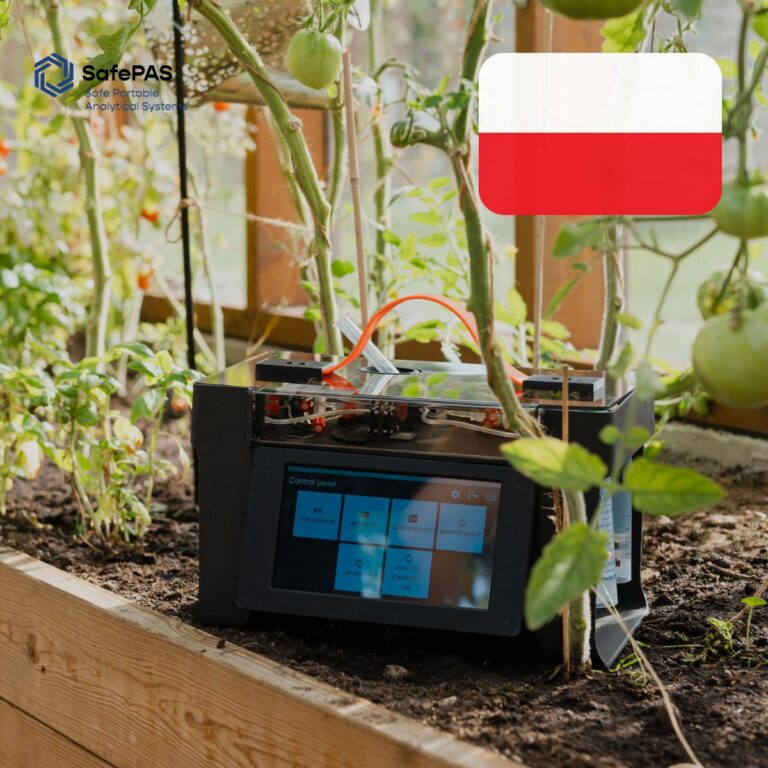
SMAGRY brings these nine ion measurements into an on-site workflow, giving agronomists quantitative evidence to consider alongside what they see in the field. Understanding what each ion contributes makes that evidence more useful—and keeps the conversation focused on the crop’s actual nutritional needs.
To explore how on-site ion analysis could fit your agronomic work, learn more about SMAGRY and request a demonstration.