Why Rhizosphere Simulation Matters: A Smarter Way to Understand Plant-Available Phosphorus
For every farmer and agronomist, soil testing is supposed to answer a very practical question: what nutrients are available to the crop right now? Not what exists somewhere in the soil in a chemically locked form. Not what can be dissolved by a strong laboratory extractant. Not what may become available under very different conditions. The real question is simpler and more urgent: what can the plant actually access through its roots in the coming days? This is especially important for phosphorus.
Phosphorus is one of the most essential nutrients for crop growth, root development, flowering, fruit formation and energy transfer inside the plant. But it is also one of the most difficult nutrients to interpret correctly. In many soils, phosphorus can be present in significant total amounts while still being poorly available to the crop. It can bind with calcium in alkaline and calcareous soils, or with iron and aluminium in acidic soils. As a result, a traditional soil test may show that phosphorus is “there”, while the crop still behaves as if it is short of available phosphorus.
That is why the extraction method matters.
The rhizosphere: where nutrient availability really happens
The rhizosphere is the narrow zone of soil directly influenced by plant roots. It is one of the most active chemical and biological environments in the field.
Roots do not simply sit in the soil and wait for nutrients to arrive. They interact with their surroundings. Root hairs and microorganisms around the roots release compounds that change nutrient solubility and help mobilise elements such as phosphorus, potassium, calcium, magnesium and micronutrients.
One important part of this process is the release of weak organic acids, including citric, malic and oxalic acids. These acids can slightly acidify the local root environment and help release nutrients from soil particles into forms that plants can absorb.
This is the basic idea behind rhizosphere simulation in soil testing: instead of asking, “What can a strong chemical extractant dissolve?”, we ask, “What would become available under conditions closer to the root environment?”
Why strong extractants can tell only part of the story
Many conventional soil tests were developed to support broad fertiliser recommendations across large agricultural systems. Mehlich-3 is one of the most widely used multi-nutrient extractants. It has been valuable for decades and remains an important reference method in many regions. But Mehlich-3 is a strong acidic extractant, with a pH around 2.5. This makes it powerful. It can dissolve nutrient pools that are not necessarily available to plants in the short term.
For some use cases, that is useful. But for precision fertigation, high-value crops, berries, vineyards, greenhouses and parcel-level decisions, a stronger extractant can sometimes create a misleading picture. It may show nutrients that exist in the soil, but not necessarily in a form the plant can access within the relevant application window.
This distinction matters. If a test overestimates available phosphorus, a grower may under-apply fertiliser and lose yield or quality. If it underestimates availability, the grower may over-apply and waste inputs. Both outcomes cost money.
The problem becomes even more sensitive in calcareous soils, where calcium-bound phosphorus can distort interpretation, and in intensive production systems where timing is everything.
H3A-4: a more plant-oriented extraction approach
The Haney H3A-4 extraction method was developed to estimate plant-available nutrients by using a dilute mixture of weak organic acids and a buffered pH of approximately 3.75. These acids are designed to mimic compounds released by plant roots in the rhizosphere.
SMAGRY did not invent the Haney H3A-4 method. The method comes from soil science research and has been used as part of the broader Haney Soil Health approach. What SMAGRY does is different: it brings this plant-oriented extraction concept into a faster, portable workflow, making it possible to measure key ionic nutrients close to the field and use the result while decisions can still be changed. This is the practical value.
A traditional laboratory result may arrive after the application window has already closed. SMAGRY is designed for same-day soil nutrient intelligence: collect the soil, extract using H3A-4, prepare the sample, run the analysis and receive quantitative ionic results in under 30 minutes.
For a farmer, that can mean the difference between reacting this week and discovering the problem too late.
Measuring ionic nutrients, not just “soil content”
Plants absorb nutrients in ionic forms. Phosphorus, for example, is commonly taken up as phosphate ions such as H₂PO₄⁻ and HPO₄²⁻, depending on soil pH. Nitrogen may be absorbed as nitrate or ammonium. Potassium, calcium and magnesium are taken up as cations.
That is why ionic measurement matters.
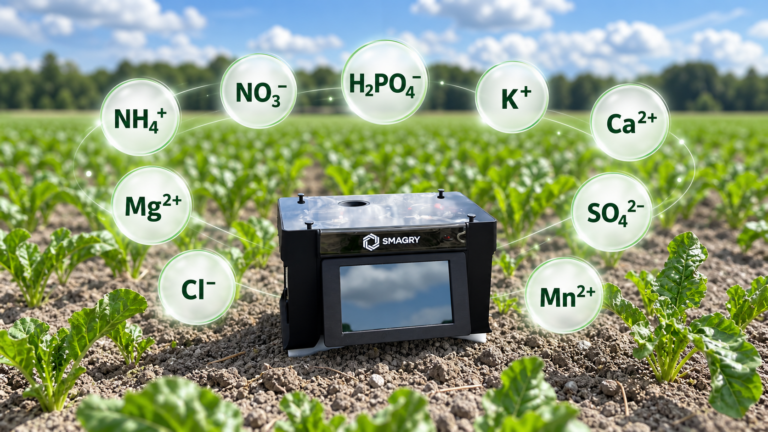
SMAGRY-nutrients is designed to measure the ions that directly drive fertilisation decisions, including: NH₄⁺, NO₃⁻, NO₂⁻, H₂PO₄⁻, K⁺, Ca²⁺, Mg²⁺, SO₄²⁻, Na⁺, Cl⁻, Fe²⁺/³⁺, Mn²⁺, Cu²⁺ and Zn²⁺.
For phosphorus management, the key point is not simply whether phosphorus exists in the soil. The key point is whether phosphate is present in a plant-accessible ionic form under conditions that better resemble the root zone. This is where H3A-4 and SMAGRY fit together.
H3A-4 helps simulate the rhizosphere more gently than harsh acidic extraction. SMAGRY then uses portable capillary electrophoresis with contactless conductivity detection to separate and quantify the ions in the extract. The result is a clearer picture of the active nutrient pool that can support near-term decisions.
H3A-4 vs Mehlich-3: not “good vs bad”, but different questions
It would be wrong to say that Mehlich-3 is simply bad and H3A-4 is simply good. They answer different questions. Mehlich-3 is a strong, widely used agronomic extraction method. It is useful for many standard soil fertility programmes and long-established regional recommendation systems.
H3A-4 is more focused on biological relevance. It is designed to approximate the chemistry of the root environment by using weak organic acids and a higher, buffered pH. In practical terms, H3A-4 often extracts lower quantities of phosphorus and potassium than Mehlich-3 because it is not trying to dissolve as much of the chemically bound nutrient pool. That difference is not a weakness. It is the point.
If the goal is to understand what may be available to the plant in the active root zone, a gentler rhizosphere-oriented extraction can provide a more relevant signal for short-term management.
This is especially important when decisions are made frequently: weekly checks in greenhouses, berry production, fertigation systems, vineyards or high-value parcels where nutrient imbalance can quickly affect quality.
Why faster testing changes the decision, not only the report
Soil testing is not valuable because it produces a number. It is valuable when that number changes a decision.
In many production systems, the timing of that decision is critical. A result that arrives two or three weeks later may still be useful for documentation or long-term planning, but it may be too late for a fertigation correction, a phosphorus adjustment, a potassium-calcium-magnesium balance check or a parcel-level response. This is the cost of “lab lag”.
When growers wait weeks for results, they may fertilise based on norms, historical assumptions or visual symptoms. By the time the data arrives, the crop has already moved on. The application window has closed. SMAGRY is designed to reduce that gap.
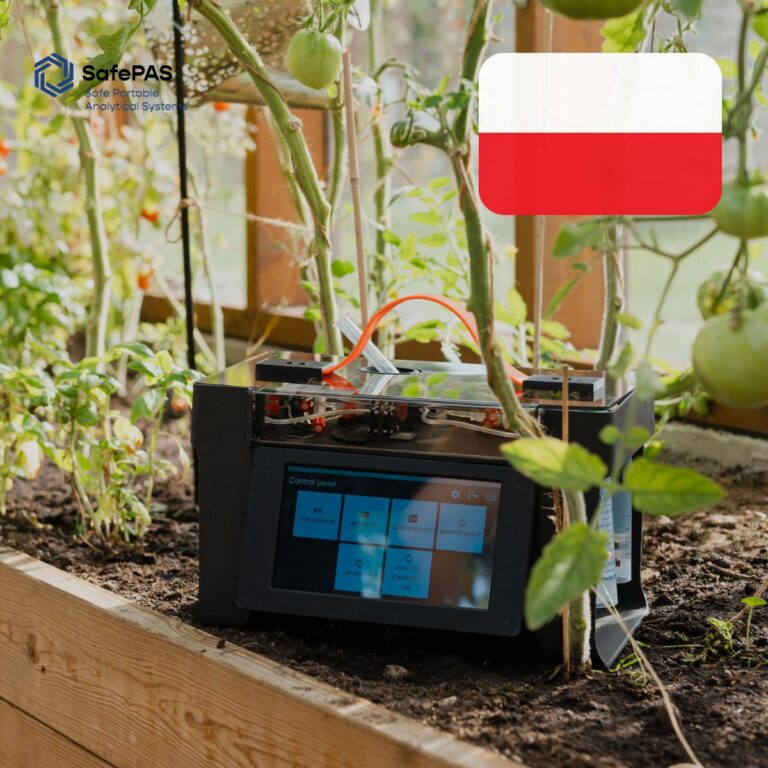
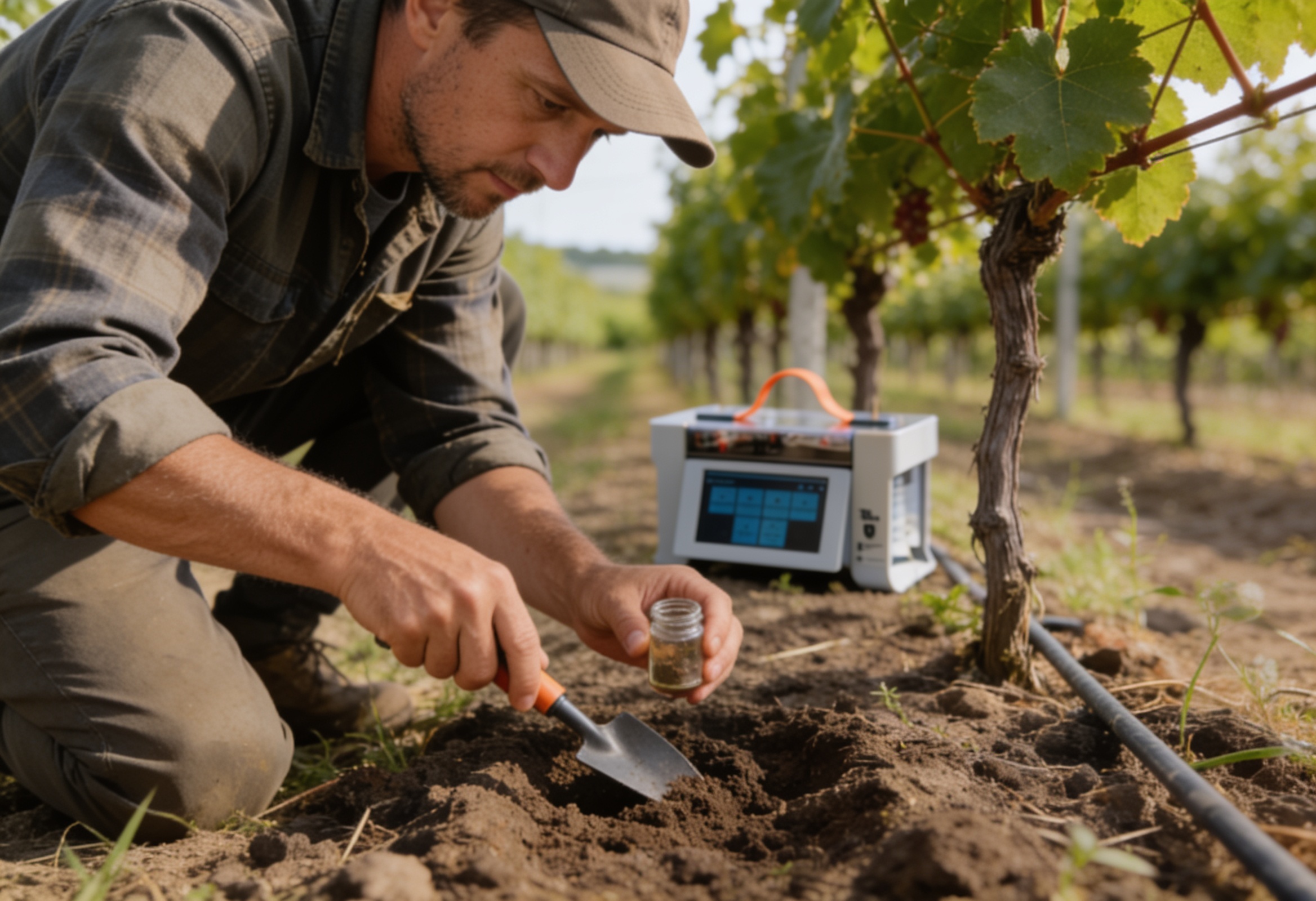
The workflow is built for practical use: collect a small soil sample, extract with H3A-4, shake, prepare, filter-inject and read the result. No full laboratory infrastructure is required. The portable unit is built for greenhouse and field operations and gives agronomists the possibility to test more often, compare parcels and adjust fertilisation before the delay becomes expensive.
Where this matters most
Rhizosphere-oriented, same-day nutrient testing is especially useful where the cost of a wrong decision is high.
In greenhouses and berry production, nutrient balance directly affects quality, shelf life and marketable yield. Weekly checks can help avoid over-fertilisation, nutrient flushing and imbalances between potassium, calcium and magnesium.
In vineyards, parcel variability is often one of the biggest management challenges. A single vineyard can contain multiple soil conditions, slopes and nutrient profiles. More frequent spot checks can support better block-level decisions and help protect grape quality.
In intensive vegetable production, the ability to monitor nitrate, ammonium, phosphate, potassium, calcium, magnesium and sulphate in a fast workflow can help agronomists move from generic recommendations to more precise nutrient steering.
In all of these cases, the goal is not to replace every laboratory test. The goal is to bring fast, quantitative nutrient insight closer to the moment of decision.
Better soil data means better input decisions
Fertiliser is expensive. Over-application wastes money and increases environmental pressure. Under-application threatens yield, quality and plant health.
The future of nutrient management will not be based only on more fertiliser. It will be based on better timing, better placement and better understanding of what the crop can actually use.
Rhizosphere simulation is an important part of that shift.
By using the Haney H3A-4 extraction method, SMAGRY focuses on the active nutrient pool rather than total soil content alone. By combining that extraction with fast portable ionic analysis, SMAGRY helps agronomists and growers make parcel-level decisions while there is still time to act.
For phosphorus, this is particularly valuable. The difference between “phosphorus in the soil” and “phosphorus available to the plant” can be the difference between a confident fertilisation plan and a costly guess. SMAGRY helps turn that question into same-day data.
From soil testing to soil nutrient intelligence
Modern farming needs more than occasional reports. It needs timely intelligence.
The rhizosphere is where the plant negotiates with the soil. It is where nutrients become available, where roots interact with microorganisms, and where small chemical changes can have a major effect on crop performance.
Testing methods that better reflect this environment can give farmers and agronomists a more practical view of nutrient availability.
SMAGRY brings this idea into the field: fast H3A-4-based extraction, quantitative ionic measurement and same-day insight for better fertilisation decisions.
Because when the crop needs an answer today, waiting weeks for data is not precision agriculture. It is missed opportunity.