Europe Wants to Measure Drug-Driving. But Can Countries Compare Their Results?
Europe may soon have more drug-driving data than ever before. That does not necessarily mean it will have comparable data.
To understand whether road-safety policies are working, authorities need to know how frequently drugs are detected among drivers, which substances are involved and whether the situation is improving. The European Trendline project has therefore developed a methodology for measuring driving under the influence of drugs as a road-safety Key Performance Indicator.
The ambition is important. Comparable drug-driving data could help governments evaluate enforcement strategies, allocate police resources and identify changes in risk. However, the Trendline methodological guidelines also expose a fundamental difficulty: countries may follow similar sampling procedures while using different saliva tests, different detection cut-offs and different substance panels.
If the underlying tests do not measure the same thing, a national percentage cannot be compared with another national percentage without considerable caution.
Europe is building a drug-driving indicator
Road deaths and serious injuries are the final outcomes of road-safety policy, but governments also need indicators that reveal what is happening before a collision occurs. Speeding, seat-belt use, alcohol consumption and driver distraction can all be monitored as risk factors. Drug driving is more difficult because the substances, analytical methods and legal frameworks vary considerably.
Trendline, supported by the European Union and involving 25 EU Member States, was created to improve the collection and harmonised reporting of European road-safety indicators. Its drug-driving methodology proposes three possible ways of measuring the percentage of drivers not driving under the influence of drugs.
The preferred method is random roadside saliva testing carried out with police support. Trendline describes this as the most accurate option for measuring prevalence in real traffic. Where legal or operational constraints make that impossible, countries may use researcher-led saliva testing or self-reported behaviour.
These three approaches are not interchangeable. The methodology states that they should be reported as separate indicators because comparability can be maintained within a method, but not necessarily between methods. A result based on police-administered saliva tests cannot be treated as equivalent to a result based on drivers reporting their own behaviour.
That is the first layer of the comparability problem. The second begins when the saliva sample is tested.
Standardised sampling does not guarantee standardised results
Trendline provides detailed guidance on how drivers should be selected. Testing should cover urban roads, rural roads and motorways, as well as weekday, weeknight and weekend periods. Drivers should be selected randomly rather than because an officer suspects drug use, and the results should be weighted to reflect traffic volumes.
These requirements help prevent a country from reporting a distorted picture based only on high-risk locations or weekend-night operations. However, two countries can follow the same sampling plan and still produce results that measure different realities.
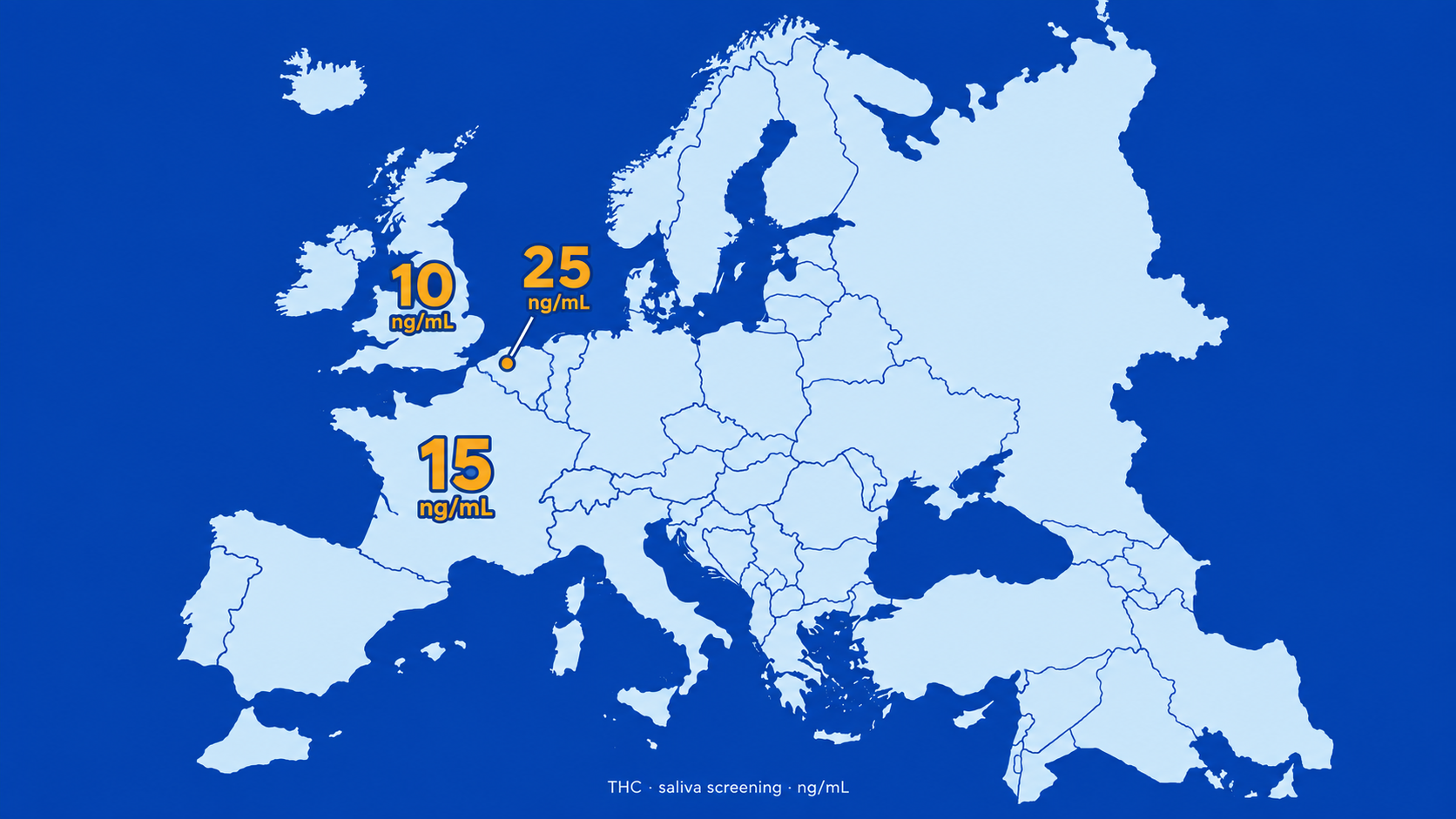
Imagine that Country A uses a saliva test with a relatively low cut-off for THC, while Country B uses a test with a higher cut-off. Even if the true pattern of cannabis use among drivers were identical, Country A could report more positive results simply because its device detects lower concentrations.
Now imagine that Country A tests only for cannabis and cocaine, while Country B also tests for amphetamines, MDMA and opioids. Country B has more opportunities to classify a sample as positive. A higher national prevalence figure may therefore reflect a broader analytical panel rather than a more serious drug-driving problem.
The percentage alone does not reveal these differences.
Why saliva-test cut-offs matter
Every drug test has a cut-off: a concentration or analytical response above which the result is classified as positive. That threshold influences how many positive results a testing programme produces.
A lower cut-off may detect more low-level traces. A higher cut-off may exclude them but also miss some cases identified by a more sensitive device. Neither result can be interpreted properly without knowing the test, the substance and the cut-off used.
Trendline explicitly acknowledges this problem. Its methodology states that oral-fluid results can be ambiguous because countries use different types of tests with their own cut-off levels. It therefore requires the specific test to be documented in the accompanying metadata and recommends monitoring developments in saliva-testing technology.
This is not merely a technical detail for laboratories. It affects the meaning of national road-safety statistics. If a government reports that 3% of tested drivers were positive, policymakers need to know what analytical threshold produced that figure before comparing it with another country or with an earlier year.
Legal differences add another complication. National drug-driving limits vary, and some systems focus on the presence of a substance while others use numerical limits or evidence of impairment. Trendline consequently states that its indicators must be interpreted against the legislative information supplied by each country.
Europe can harmonise the format of an indicator, but that does not automatically harmonise what constitutes an offence.
Different substance panels create different versions of drug driving
A saliva test can report only the substances included in its defined analytical panel. This means that the scope of the panel becomes part of the measurement itself.
Trendline notes that some countries use several types of drug test and that there is currently no comprehensive overview of every substance detected by the devices used across participating countries. The guidelines recommend reporting results for commonly detected drugs separately rather than relying only on one combined positive rate.
This distinction is essential. “Drug-positive drivers” are not a chemically uniform group. Cannabis, cocaine, amphetamines and opioids have different patterns of use, detection windows and operational implications. A combined figure may be useful as a high-level indicator, but it can conceal the substances driving the result.
The same principle applies when test panels change over time. If a country adds another substance to its testing programme, its positive rate may rise even if driver behaviour remains unchanged. Without clearly documented panel information, that increase could be misinterpreted as a worsening national trend.
No targeted analytical system can report a substance outside its validated panel. Transparent drug-driving data therefore requires authorities to state not only what was found, but also what the test was capable of finding.
Polysubstance use cannot be reduced to one positive result
Drug-driving programmes must also account for samples containing more than one substance. Trendline recommends distinguishing between single-drug and multiple-drug results, while its final report calls for poly-drug use to be reported separately because of its heightened risk.
A binary “any drug detected” indicator loses this information. A sample containing only THC and a sample containing THC, cocaine and an amphetamine could both be counted as one positive driver, even though the analytical and risk profiles are very different.
The ability to record several identified substances separately is therefore relevant to both enforcement and public policy. It helps authorities understand which combinations occur, whether particular patterns are becoming more common and where prevention or enforcement resources may be required.
Polysubstance reporting also makes the scope of the testing panel especially important. A narrow test may classify a multidrug case as a single-substance result simply because it was not designed to detect the other substances present.
Comparable drug-driving data requires an analytical standard
Europe does not necessarily need identical drug-driving laws before it can improve the quality of its data. It does, however, need a clearer analytical basis for comparison.
At minimum, every reported indicator should identify the sampling method, oral-fluid collection procedure, test model, version, substance panel and cut-off applied to each substance. Authorities also need consistent definitions for positive, negative and inconclusive results, as well as an agreed way to record multiple substances in one sample.
Where countries want stronger international comparability, a shared testing protocol would need to go further. Participating authorities would use equivalent panels and analytical cut-offs, follow the same quality-control procedures and report results in a common structure. Changes to a device, panel or threshold would have to be recorded so that an apparent trend could be distinguished from a change in measurement.
The Trendline final report reaches a similar conclusion. It recommends standardising device requirements to establish minimum sensitivity and comparability, harmonising the substances tested and reporting poly-drug use separately.
In other words, comparable statistics begin with comparable measurement.
What this means for police and public-sector procurement
For police forces and road-safety authorities, the question is not only how quickly a test produces a result. Procurement decisions can also determine the quality of the data available for future policy.
A device selected for operational screening may answer whether one of several drug classes triggered a preliminary test. A system intended to contribute to national monitoring may need to provide considerably more information: the identified substance, its measured concentration, the applied analytical threshold and whether additional substances were detected in the same sample.
The intended role of the result must also be defined. A screening result, an analytical field measurement and an evidential result are not automatically equivalent. Each requires an appropriate validation framework, operator procedure and legal interpretation.
This is why a testing programme should be designed as a complete measurement system rather than as a collection of individual devices. Sampling, analysis, reporting, quality control and metadata all influence whether the final data can support meaningful comparisons.
Where Drug Hunter fits
Drug Hunter is a portable oral-fluid analyser designed to identify selected substances and measure their concentrations directly in saliva. Its defined panel includes amphetamines, MDMA-group substances, cocaine, tramadol, codeine, morphine and cannabinoids.
This approach is relevant to the Trendline challenge because it provides substance-specific, quantitative information rather than only a broad positive or negative indication. It can also identify multiple selected substances in the same sample, supporting a more detailed view of polysubstance use.
Used under a common validated protocol, quantitative analysis could make it easier to understand whether results from different locations were generated using equivalent analytical conditions. It could also give public authorities more useful data for separating substance-specific trends from changes caused by test sensitivity or panel composition.
Drug Hunter does not make national laws identical, and it does not discover unknown substances outside its defined panel. A measured saliva concentration does not automatically establish impairment or translate directly into a blood concentration. Evidential use remains dependent on validation, national legislation and the applicable operational procedure.
Its potential contribution is more specific: bringing clearly defined, quantitative and multi-substance oral-fluid analysis closer to the place where the sample is collected.
From harmonised indicators to trustworthy comparisons
SafePAS has previously examined why a roadside saliva result may differ from a later blood result and what quantitative saliva testing can add to the interpretation of an individual sample. Trendline raises a different question at the system level.
Even if every national testing programme works exactly as intended, can their aggregated results be compared?
The answer is: only if the differences behind those results are visible and controlled. Countries must know which drivers were selected, which substances were tested, which cut-offs were applied, how multiple substances were recorded and which national legal framework shaped the indicator.
Trendline represents an important step towards a European drug-driving KPI. Its methodology provides a common structure for collecting data and makes the remaining analytical gaps unusually clear. The current Trendline Plus project continues the wider effort to improve harmonised road-safety monitoring across Europe.
The next step is to connect statistical harmonisation with analytical harmonisation. Europe does not simply need more saliva tests. It needs results whose scope and meaning are sufficiently clear to support comparison.
Frequently asked questions
Can European countries currently compare their drug-driving rates?
Only with significant qualifications. Comparability depends on the data-collection method, sampling design, saliva test, cut-offs, substance panel and national legal framework. Results produced by different methods or analytical configurations should not be treated as directly equivalent.
Why do saliva-test cut-offs affect national statistics?
The cut-off determines when a result is classified as positive. A lower cut-off may identify concentrations that a higher-cut-off test does not report. Two countries testing similar driver populations can therefore produce different positive rates because of their devices rather than because driver behaviour is different.
Why should countries report individual substances separately?
Different test panels cover different drugs, and a combined positive rate can hide which substances produced the result. Substance-specific reporting makes it easier to compare equivalent categories and identify meaningful changes in drug-use patterns.
Why is polysubstance use important for drug-driving data?
A driver may test positive for more than one substance at the same time. Recording only a single positive result hides that information. Trendline recommends separating single-drug and multiple-drug cases so that their prevalence and risk profiles can be assessed more accurately.
Does a quantitative saliva result prove that a driver is impaired?
No. A measured concentration provides more information than a binary result, but it does not independently prove impairment. Interpretation depends on the substance, validated method, collection time, national law, observed behaviour and any required confirmatory analysis.
Can Drug Hunter detect new or unknown drugs?
No. Drug Hunter analyses substances included in its defined panel. It should not be presented as a system for discovering previously unknown substances. Its role is to identify selected targets, measure their concentrations in saliva and report multiple detected panel substances separately.
If your organisation is developing a roadside drug-testing programme, public-sector pilot or research project, contact SafePAS to discuss how portable quantitative oral-fluid analysis could support more clearly defined operational and data-collection workflows.