Positive at the Roadside, Below the Limit in Blood: Why Drug-Test Results Diverge
A roadside drug test returns a positive result. The driver is removed from the road, an evidentiary sample is arranged, medical or police personnel become involved, and the sample is sent for laboratory analysis. Hours or days later, the conclusion is different: the laboratory does not find the substance above the level required for prosecution.
To the driver, this may look like a simple false positive. To the police officer, it may look like a screening device that cannot be trusted. To the laboratory, however, the two results may not necessarily contradict one another.
A roadside screening test and a confirmatory blood analysis answer different questions. They may examine different biological samples, look for different chemical targets, apply different cut-offs and take place at different points in time. The law then adds another layer: the same measured trace can have different consequences depending on the country in which the driver was stopped.
This is why a positive roadside drug test is not a final verdict. It is the beginning of an analytical and legal process.
Why can a roadside saliva test and a blood test reach different conclusions?
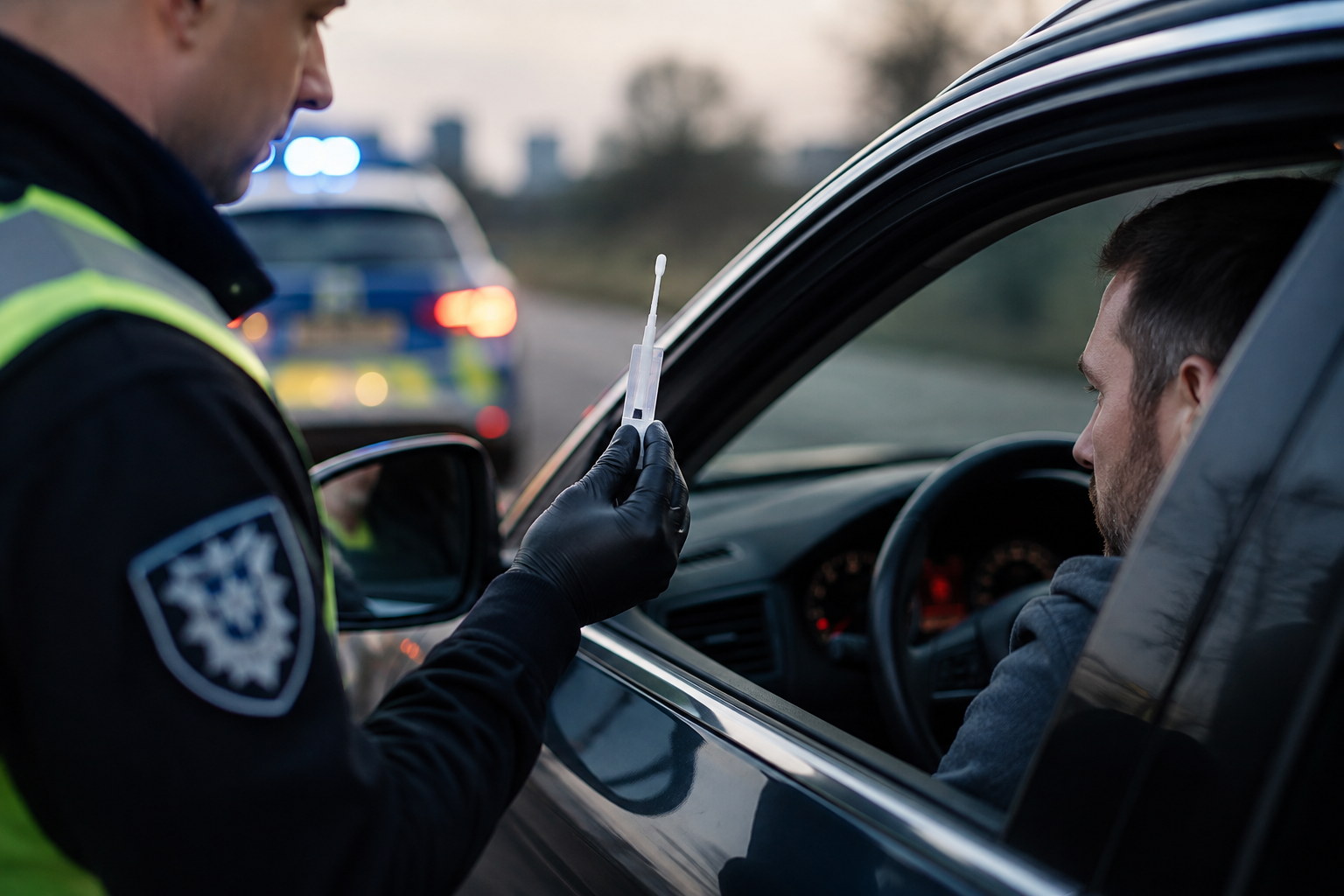
Roadside drug testing is designed for speed and practicality. Police need a method that can be used close to the driver, without transporting every person immediately to a hospital or laboratory. Oral fluid is well suited to this first stage because the sample can be collected under observation and analysed close to the point of contact.
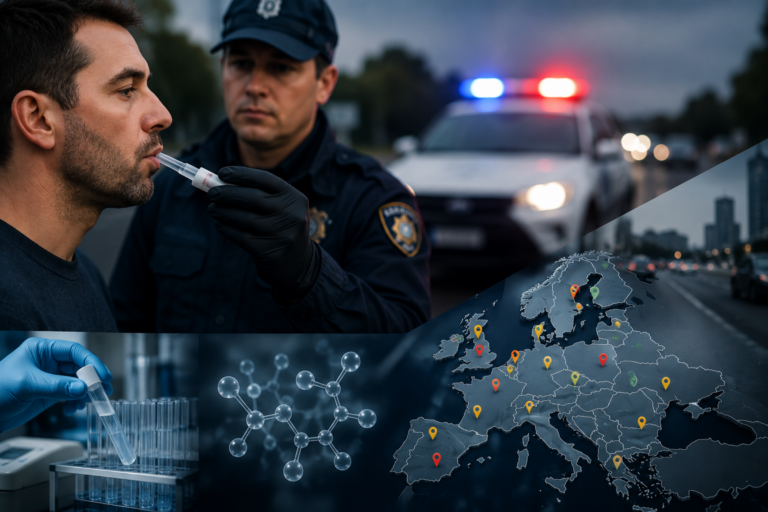
In many European countries, however, the roadside result is only a preliminary screen. The European Union Drugs Agency reports that approximately half of European countries use saliva testing at the roadside, while nearly all require some form of confirmatory blood testing for prosecution. The blood sample is usually collected in a hospital or another approved setting.
That sequence creates several opportunities for the results to diverge.
The saliva test may react to a drug or drug class at the roadside, while the later blood result falls below the country’s statutory threshold. The concentration may decline during the interval between the two samples. The roadside device may use a screening cut-off that does not correspond directly to the legal blood limit. It may detect a related compound or metabolite rather than the exact substance used in legislation. In some cases, the preliminary test may simply have reacted incorrectly.
All these outcomes are often described casually as false positives. Scientifically and operationally, they are not the same.
Is every roadside result that fails confirmation a false positive?
No.
The phrase false positive is frequently used too broadly.
A true analytical false positive occurs when a test indicates that its target is present even though it is not. This may result from cross-reactivity, sample contamination, device limitations, operator error or another interference.
But a roadside result may also be analytically correct and still fail to support prosecution. The test may have detected a real substance at a concentration below the applicable legal threshold. It may have detected a residual trace from earlier use. It may have reacted to a broad drug class, while the confirmatory analysis looked for one specific compound. The substance may also have been present at the roadside but declined before blood collection.
This distinction matters because the operational problem is larger than test accuracy alone.
A screening result can be chemically real but legally insufficient. It can identify exposure without proving current impairment. It can trigger an expensive chain of procedures while giving officers very little information about what was detected or how much was present.
A better question is therefore not simply:
Was the roadside test right or wrong?
It is:
Did the roadside result provide enough information to justify what happened next?
What does a standard rapid roadside test actually report?
Many rapid roadside systems use immunoassay technology. Their role is generally to indicate whether a chemical signal associated with a drug class exceeds the device’s screening cut-off.
The result is typically binary:
- positive;
- negative.
That simplicity is useful when police need to screen people quickly. But it compresses several different questions into a single result.
A positive test does not necessarily tell the officer:
- which exact substance triggered the reaction;
- how much of it is present;
- whether several substances are involved;
- whether the concentration is likely to exceed a legal blood limit;
- whether the person is impaired;
- when the substance was consumed.
This does not make rapid immunoassays useless. They perform a valuable first-stage function. The limitation is that a class-level positive may be treated as though it were a complete analytical conclusion when it is only a preliminary signal.
That distinction becomes particularly important when the next step requires police transport, medical personnel, blood collection, laboratory capacity and administrative processing.
Why is THC particularly difficult?
Cannabis is the clearest example of why presence, concentration and impairment should not be treated as synonyms.
THC concentrations change over time, but not in a perfectly predictable way across all individuals. The result can be influenced by the time since use, frequency of use, route of administration, individual metabolism and the biological sample being tested. A measurable trace may therefore confirm exposure without demonstrating that the driver is currently impaired.
The legal treatment of that trace also differs sharply across Europe.
Germany uses a statutory THC level of 3.5 ng/mL in blood serum for the relevant administrative offence. Belgium and Denmark use 1 ng/mL, while Czechia uses 2 ng/mL. France applies a presence-based model without a general numerical blood threshold in the EUDA comparison, and Spain’s administrative system may treat the presence of a drug in saliva or blood as sufficient. Estonia does not specify a national numerical blood-drug limit in the EUDA overview and combines rules concerning detected use with impairment-based criminal provisions ( https://www.euda.europa.eu/publications/topic-overviews/legal-approaches-to-drugs-and-driving/html_en ).
England and Wales use a blood limit of 2 micrograms per litre, equivalent to 2 ng/mL, for delta-9-THC. The UK government describes its framework for commonly abused illegal drugs as a zero-tolerance approach, with limits set high enough to rule out plausible accidental exposure rather than to represent a universally agreed impairment level ( https://www.euda.europa.eu/publications/topic-overviews/legal-approaches-to-drugs-and-driving/html_en )
These approaches reflect different legal philosophies. Some systems prioritise detecting illicit drug use. Others set per-se limits. Others focus more heavily on demonstrated impairment. EUDA notes that Europe has not reached a single scientific or legal consensus on the drug concentrations that establish impaired driving, which is one reason national approaches remain so different ( https://www.euda.europa.eu/publications/topic-overviews/legal-approaches-to-drugs-and-driving/html_en )
The chemistry may be identical.
The legal interpretation is not.
How can time between the two samples change the outcome?
Time is not a minor administrative detail. It is part of the analytical result.
A roadside saliva sample may be collected shortly after the police stop. A blood sample often requires transport, an approved location and a qualified medical professional. During that interval, the concentration of a drug in the body can change.
This issue was explicitly identified in a Dutch public-sector challenge concerning drug-driving enforcement. According to the source supplied to SafePAS, approximately 40% of positive pre-selections—whether obtained through a psychomotor test or saliva screening—did not ultimately result in a substance being found above the legal threshold. The source points in particular to the delay between the saliva test and blood collection, which must be performed by a doctor or nurse and is therefore not always possible immediately. The problem was described as especially relevant for THC.
That figure should not be interpreted as proof that 40% of all roadside devices are analytically wrong. It describes a wider operational mismatch between preliminary screening and the legal conclusion reached later.
The test may have reacted correctly at the time of the stop. Yet by the time the evidentiary sample is collected, the concentration may no longer exceed the required threshold. Alternatively, the original concentration may never have been high enough to meet that threshold.
Either way, significant resources have already been committed.
What happens after a positive roadside drug test?
The precise procedure varies by jurisdiction, but the pathway usually involves several stages.
The driver may first undergo a roadside screening test or impairment assessment. A positive or suspicious result can then lead to arrest, removal from driving, transport to another location, collection of a blood or urine sample and laboratory analysis. Documentation, custody procedures and later legal review may follow.
In England and Wales, for example, police may use roadside kits to screen for cannabis and cocaine. Where an officer suspects drug impairment, the driver can be arrested and required to provide a blood or urine sample. The statutory offence is ultimately based on specified concentrations in blood, not simply on the roadside screening result ( https://www.gov.uk/drug-driving-law ).
Each step is justified when the case genuinely requires escalation. The difficulty arises when the initial result contains too little information to distinguish a strong case from a marginal or ambiguous one.
The burden is not only financial. It includes:
- police time;
- transport and custody capacity;
- doctors or nurses;
- evidentiary sample collection;
- laboratory queues;
- administrative work;
- delayed decisions;
- consequences for the person tested.
Even where no prosecution follows, the intervention has already happened.
Why do screening cut-offs and legal limits not always align?
A screening device has its own analytical cut-off. National legislation may define a separate blood concentration. These values are not interchangeable.
A roadside saliva cut-off is designed around the performance of the device, the properties of oral fluid and the intended screening workflow. A statutory blood limit is defined by legislation and applied to a different biological matrix. There is no universal conversion formula that turns a saliva concentration into an equivalent blood concentration for every person and every substance.
This means that a positive oral-fluid screen may occur even when a later blood result falls below the legal limit. That does not necessarily indicate a malfunction. It may show that the screening threshold is intentionally cautious, that the relationship between saliva and blood is variable, or that the national limit serves a different policy objective.
The problem becomes more serious when the roadside result gives officers only a class-level answer. Without a measured concentration or exact substance identification, they have limited information with which to evaluate how strongly the case merits escalation.
What can quantitative oral-fluid analysis change?
Quantitative testing cannot remove biology, legal differences or the need for confirmatory analysis. It can, however, provide more useful information at the point where the first decision is made.
Instead of reporting only that a drug class produced a reaction, a substance-specific quantitative system can indicate:
- which selected substance was identified;
- what concentration was measured in oral fluid;
- whether more than one selected drug is present;
- whether the result is marginal or substantially above an operational cut-off;
- what information should accompany the case into the next stage.
Drug Hunter is designed for this role. It identifies and quantifies selected drugs directly from oral fluid, giving trained professionals a clearer result before they decide on laboratory confirmation, enforcement action or additional procedures.
This does not mean that a saliva concentration automatically determines whether the driver has violated the law. It does not establish impairment on its own, and it does not replace blood analysis where national procedure requires it.
Its value lies in improving preselection.
A conventional screening result may say:
Positive for cannabinoids.
A quantitative result can provide a more precise statement:
Delta-9-THC was identified in the oral-fluid sample at a measured concentration.
The second statement does not make the legal decision.
It gives the people responsible for that decision more information.
Could quantitative testing eliminate all unnecessary blood tests?
No responsible analytical system should make that promise.
Blood testing remains central to drug-driving prosecution in many countries. EUDA reports that nearly all European jurisdictions require a confirmatory blood test or another evidentiary procedure before prosecution ( https://www.euda.europa.eu/publications/topic-overviews/legal-approaches-to-drugs-and-driving/html_en ).
Quantitative oral-fluid analysis should therefore be understood as an improved preselection tool, not as a universal replacement for the evidence chain.
It may help reduce unnecessary escalation where local protocols allow officers to use concentration data in their decision-making. It may help laboratories prioritise samples. It may provide a stronger analytical record of what was present closer to the time of the stop. It may also reveal multidrug situations that a broad binary result does not explain.
The actual impact will depend on national law, validated cut-offs, police procedures and the role assigned to the device by the competent authority.
Technology can improve the quality of the information. Institutions decide how that information may be used.
Why does terminology matter?
Calling every unconfirmed result a false positive may create the wrong impression.
It suggests that roadside devices simply produce imaginary results. Sometimes they do react incorrectly, but many cases are more nuanced. A real drug may have been detected below the legal threshold. A concentration may have declined before blood collection. The roadside and laboratory methods may have measured different targets. The legal system may also demand a higher level of proof than the screening device was designed to provide.
A more accurate description is often:
- unconfirmed positive;
- positive preselection without legal exceedance;
- screening result not supported above the statutory threshold;
- analytically positive but legally insufficient.
This language matters because better policy begins with a correct diagnosis of the problem.
If the issue is cross-reactivity, the solution is better selectivity. If the issue is delay, the solution may involve faster sample collection or earlier quantitative analysis. If the issue is misaligned cut-offs, the screening protocol must be reconsidered. If the issue is residual traces, authorities need better interpretation rather than simply more sensitive detection.
What should law-enforcement agencies ask when evaluating a roadside test?
The most useful procurement question is not merely, “How quickly does it produce a result?”
Authorities should also ask:
- Does the system identify a drug class or a specific substance?
- Does it provide a measured concentration?
- What is the analytical cut-off for each substance?
- How does that cut-off relate to local operational and legal thresholds?
- What interferences or cross-reactions have been evaluated?
- Can it detect several selected substances in the same sample?
- How is the result documented?
- Can the sample be retained for additional analysis?
- What role will the result play in the national evidence chain?
- What independent validation supports the intended use?
A fast answer is useful. A fast answer that lacks the detail needed for the next decision may simply move uncertainty further down the process.
Toward more informative roadside testing
Roadside testing has already changed drug-driving enforcement by allowing police to collect information closer to the moment of concern. The next step is not merely to make the same binary tests slightly faster. It is to improve the quality of the information available before the most resource-intensive procedures begin.
A positive screening result should not be mistaken for proof of impairment. Nor should every failure to confirm a legal exceedance be dismissed as a defective test. Between those two extremes lies the real analytical problem: substances, concentrations, biological timing, cut-offs and national laws do not always line up neatly.
Quantitative oral-fluid analysis cannot resolve every part of that problem. It can make the first result more informative.
For police, that may mean better preselection. For laboratories, better prioritisation. For the person being tested, it may mean a process based on more than a broad, unexplained positive. And for public authorities, it offers a practical route toward using enforcement resources where they are most justified.
The purpose of better roadside testing is not to make fewer cases proceed at any cost. It is to make sure that the right cases proceed for the right reasons.
FAQ
Can a roadside drug test be positive and a blood test negative?
Yes. The roadside test and blood analysis may use different samples, methods, targets and cut-offs. The drug concentration may also decline between sample collections. In some cases, the substance is detected but remains below the statutory blood limit.
Does a positive saliva test prove that a driver is impaired?
No. A positive saliva test shows that the device detected its target above its screening cut-off. Impairment is a separate medical and legal question and may require behavioural evidence, blood analysis or another formal procedure.
Are all unconfirmed roadside results false positives?
No. Some are true analytical false positives, but others involve genuine drug detection below the legal threshold, residual traces, changing concentrations or a mismatch between screening and evidentiary cut-offs.
Why are cannabis results particularly difficult to interpret?
THC concentrations change over time and may be influenced by how recently and how frequently cannabis was used. Countries also apply different legal models and blood limits, so the same trace may not have the same legal significance everywhere.
Can saliva concentration be converted directly into blood concentration?
Not through a universal formula. The relationship varies by substance, time since use, individual biology and sampling conditions. Saliva and blood results must be interpreted within validated protocols.
Does Drug Hunter replace confirmatory blood analysis?
No. Drug Hunter provides substance-specific, quantitative oral-fluid information to support better on-site preselection. Confirmatory laboratory analysis remains necessary wherever national law or procedure requires it.
What does Drug Hunter report?
Drug Hunter identifies and quantifies selected substances in oral fluid. This gives trained professionals more information than a broad positive or negative drug-class result.
Make the first result more informative
Drug Hunter provides substance-specific, quantitative oral-fluid results to support clearer roadside decisions before cases move into laboratory confirmation and further procedures.
Contact SafePAS to discuss a Drug Hunter demonstration, pilot deployment or distribution partnership.
Legal note: This article provides a general overview and is not legal advice.
Drug-driving laws, analytical thresholds and evidentiary procedures vary between countries and may change. Operational decisions must follow current national legislation and validated local protocols.