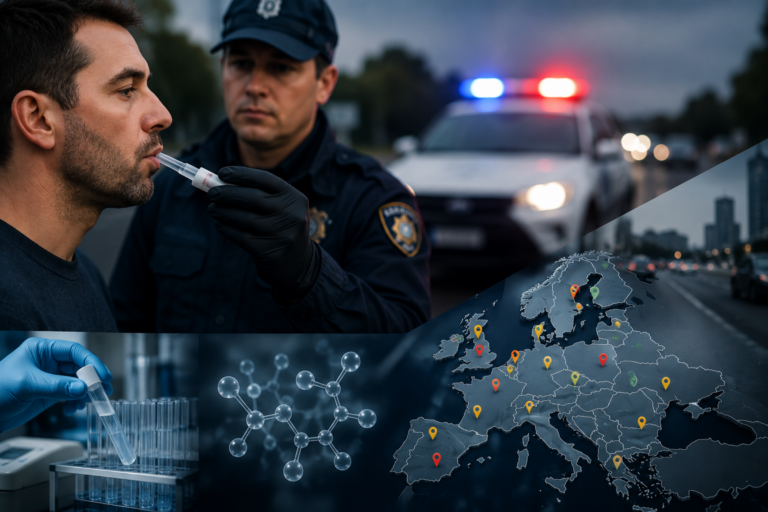

Cannabinoid markets on the move: trends in Europe and the United States
Cannabis has long been the most widely used illicit drug in Europe and the United States. What is changing rapidly is the nature of the market itself. Diversification into high‑potency strains, a boom in edibles and vapes, and the rise of synthetic and semi‑synthetic cannabinoids are reshaping both consumption patterns and the way authorities need to monitor them. The European Union Drugs Agency (EUDA) and U.S. surveillance systems show that the cannabis economy has grown into a multi‑billion‑euro business, while new technologies are needed to keep pace with evolving substances and legal frameworks.
Jekaterina Mazina-Šinkar, CEO of SafePAS and an expert in methods for detecting narcotic substances in the human body, helps break down the current situation and analyzes discussion threads.

Europe: a complex and diversified cannabis landscape
Prevalence and market value
According to the European Drug Report 2025, cannabis remains by far the most commonly consumed illicit drug in the European Union. The EUDA estimates that 8.4 % of European adults – roughly 24 million people aged 15–64 – used cannabis in the last year. Cannabis accounts for the largest share of the EU’s illicit drug market, with a retail value estimated at EUR 12.1 billion. Around 1.5 % of adults (about 4.3 million people) are daily or almost‑daily consumers. These heavy users are more likely to experience health problems such as cannabis dependence, respiratory symptoms and psychosis.
The potency of cannabis products has increased markedly. EUDA notes that high‑potency resin and herbal products dominate seizures, and this trend has been linked to rising treatment demand. Cannabis now accounts for more than a third of all drug treatment admissions in Europe, and over two‑fifths of first‑time treatment entrants. People entering treatment for cannabis tend to be older than before and often take longer to seek help, suggesting that heavy use and high‑potency products are creating longer‑term dependency.
Europe’s regulatory response is cautious and fragmented.
Countries such as Germany, Malta and Luxembourg have introduced limited legalisation models, while others retain prohibition or permit only medical use. This patchwork requires law‑enforcement agencies to differentiate between legal vs. illegal possession, medical vs. recreational use and natural vs. synthetic cannabinoids. Cross‑border differences make it difficult to track flows of new products and ensure coherent public‑health responses.
Waste‑water evidence and its limits
Wastewater‑based epidemiology offers a rare objective measure of drug consumption. The EUDA’s multi‑city study detects cannabis through the metabolite THC‑COOH and confirms that cannabis use is widespread across all European cities. The highest loads of THC‑COOH were observed in cities in the Netherlands, Germany and Slovenia, while Canadian and U.S. cities showed even higher levels. Overall, loads of cannabis metabolites in wastewater remained stable between 2024 and 2025, with 33 % of cities reporting increases and 44 % showing decreases.
However, waste‑water analysis cannot distinguish between different cannabinoids – it measures only THC‑COOH. As the cannabis market diversifies into synthetic and semi‑synthetic products, laboratory and roadside tests that focus on classical cannabis markers risk missing emerging substances.
The EU’s Early Warning System recorded an unprecedented number of new cannabinoids in 2024. Out of 20 new cannabinoids identified that year, 18 were semi‑synthetic. By the end of 2024, 24 semi‑synthetic cannabinoids had been detected on European drug markets, including hexahydrocannabinol (HHC), HHC‑O, HHC‑P and delta‑9‑THCP. These compounds are chemically modified versions of plant cannabinoids and were initially imported from the United States, but are now also produced in Europe. Their effects are poorly understood; reports suggest they can trigger adverse reactions ranging from mild to severe poisoning.
Semi‑synthetic cannabinoids are marketed as legal alternatives and are widely available online, in vape shops and even vending machines. Flavoured edibles and vapes containing these substances may attract youth and novice users and have led to outbreaks of poisoning. Laboratory analyses show high variability in the concentration and composition of these products, increasing the risk of accidental overdoses. As Europe tightens controls (HHC is now scheduled in at least 22 EU member states), producers pivot to new analogues, highlighting the cat‑and‑mouse nature of regulation.
United States: rapid expansion amid shifting regulations
Usage and market size
Legalisation in the United States has transformed cannabis from an illicit product into a mainstream commodity. Adult‑use cannabis is now legal in 24 states, and 79 % of Americans live in a county with at least one dispensary. According to a synthesis of Gallup and National Survey on Drug Use and Health (NSDUH) data, about 15 % of Americans are “current” marijuana users, and 22.3 % of people aged 12+ (around 64 million individuals) used cannabis in the past year. Almost half of U.S. adults report that they have tried cannabis, and public support for legalising cannabis stands at 87 %. The legal cannabis industry is projected to reach almost USD 47 billion in 2026 and already supports roughly 425 000 full‑time jobs.
The U.S. market is diversifying beyond traditional flower products. Retail sales data show strong growth in pre‑rolled joints, edibles, beverages and vapes, reflecting consumer appetite for convenience and discreet consumption. An important sub‑segment is hemp‑derived semi‑synthetic cannabinoids such as delta‑8‑THC and HHC, which exploit a regulatory loophole from the 2018 Farm Bill that legalised hemp production. These compounds, often marketed as “legal highs,” occupy a grey zone between federal and state laws. Several states have banned delta‑8 or restricted its sale, while others allow it to be sold alongside CBD products.
THC concentrations in U.S. cannabis products have risen sharply over the past two decades. Potent concentrates and high‑THC flower now dominate legal markets, and about 42 % of cannabis consumers are considered “intensive users” who consume daily or near‑daily. Public health research suggests that 30–32 % of users may meet criteria for cannabis use disorder (CUD). Youth usage remains a concern; roughly 25.7 % of U.S. 12th graders reported using cannabis in 2025, and daily use was reported by about 5.6 % of high school seniors. High‑potency products are linked to greater risks of dependency and mental‑health issues such as psychosis and depression.
Semi‑synthetic cannabinoids and the regulatory gap
The U.S. hemp market has become a major source of semi‑synthetic cannabinoids. Delta‑8‑THC, HHC and other hemp‑derived THC analogues are produced by chemically converting cannabidiol (CBD) extracted from hemp. These compounds are psychoactive yet remain outside the definition of “marijuana” in federal law. Manufacturers argue that they are legal because they originate from hemp, while regulators contend that synthetic conversions fall under controlled substances. This ambiguity has created a thriving market in states where recreational cannabis remains illegal. At the same time, semi‑synthetic cannabinoids from the U.S. have quickly entered European markets, prompting controls in multiple EU countries.
Why detection is becoming more complex
Across both continents, the monitoring of cannabinoids still relies heavily on classical markers – Δ⁹‑THC and its metabolites 11‑hydroxy‑THC and 11‑nor‑9‑carboxy‑THC (THC‑COOH). Rapid immunoassay tests often focus on THC‑COOH, which is inactive and persists in the body long after consumption. This means that positive results do not necessarily indicate recent impairment. Conversely, many emerging cannabinoids produce different metabolites that escape detection by tests designed for THC. Semi‑synthetic cannabinoids like HHC and delta‑8‑THC can yield metabolites that are not targeted by standard assays, while synthetic cannabinoid receptor agonists have entirely distinct metabolic pathways. Waste‑water analysis suffers from a similar limitation, as it measures only THC‑COOH.
The analytical gap creates several problems:
- Under‑detection of emerging substances. Because testing focuses on classical THC markers, users of semi‑synthetic cannabinoids may go undetected, skewing epidemiological data and making it harder to assess the size of the problem.
- Misinterpretation of results. Positive tests for THC‑COOH may reflect past use rather than current impairment, complicating enforcement of drug‑driving laws and workplace policies.
- Policy decisions based on incomplete data. Legislators rely on surveillance data to craft regulations. If new cannabinoids are not detected, policymakers may underestimate their prevalence or associated harms.
Drug Hunter: bridging the detection gap
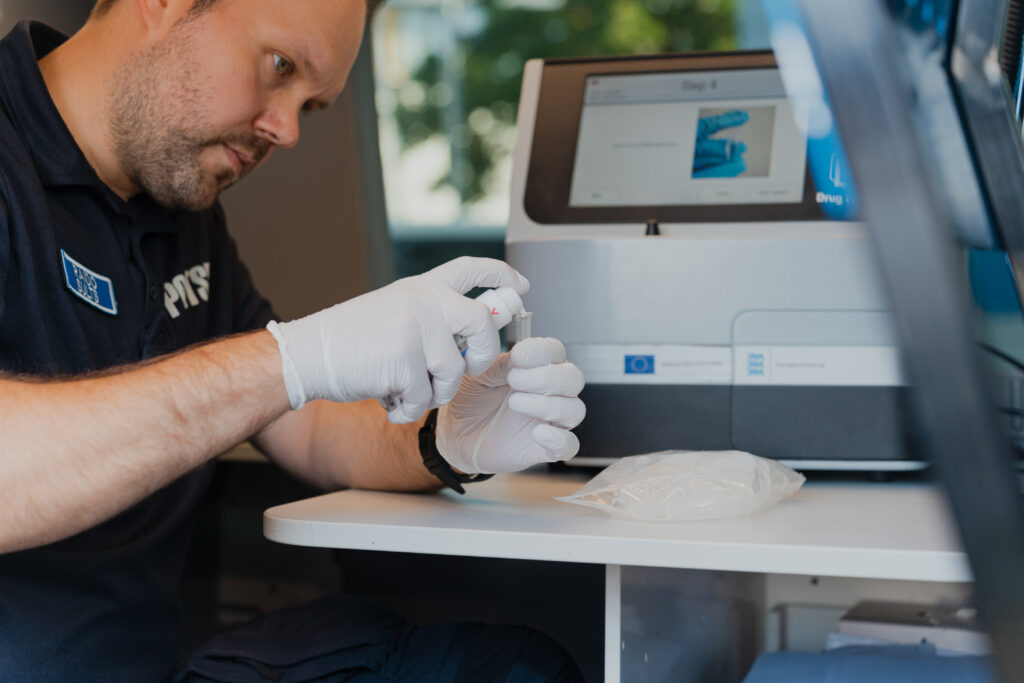
SafePas’ Drug Hunter was designed to address exactly these challenges. It is a portable analytic platform that allows rapid, on‑site screening of a wide range of drug classes, including both plant‑derived cannabinoids and semi‑synthetic analogues. Instead of looking solely for THC or its primary metabolites, Drug Hunter employs advanced mass‑spectrometric methods to detect multiple cannabinoids simultaneously, including emerging compounds. This broader scope means that law‑enforcement officers and health professionals can quickly identify whether a sample contains Δ⁹‑THC, delta‑8‑THC, HHC, THCV, CBG or other novel analogues, and flag suspicious samples for laboratory confirmation.
Drug Hunter also supports data collection and trend analysis. Because it can be deployed at the roadside, at customs checkpoints or in clinical settings, it generates geo‑tagged, time‑stamped data on detected substances. When aggregated, this information can reveal real‑time patterns of cannabinoid use, helping authorities monitor the spread of semi‑synthetic cannabinoids or the emergence of new derivatives. By prioritising samples that contain unknown or dangerous compounds, Drug Hunter enables laboratories to allocate resources more effectively.
In jurisdictions with fragmented laws, a technology like Drug Hunter provides clarity. It helps differentiate between legal hemp products and illicit semi‑synthetic cannabinoids, reducing unnecessary prosecutions while ensuring that harmful substances are not overlooked. As semi-synthetic cannabinoids continue to evolve, testing technologies must be able to rapidly adapt and detect newly emerging compounds.
Conclusion
The cannabis landscapes in Europe and the United States are evolving in unprecedented ways. Europe faces a fragmented legal environment and an influx of semi‑synthetic cannabinoids, with 24 new compounds detected by the end of 2024. Wastewater analysis confirms widespread use but cannot keep up with the diversity of new substances. Treatment demand and high‑potency products continue to pose public‑health challenges.
The United States has embraced legalisation and seen explosive growth. 15 % of Americans are current cannabis users and 64 million people report past‑year use. The industry is valued at tens of billions of dollars and is rapidly diversifying. But rising potency, heavy use and semi‑synthetic cannabinoids raise concerns about dependency and regulatory loopholes.
In both regions, traditional testing methods are no longer sufficient. They focus on a narrow set of THC markers and therefore under‑detect emerging cannabinoids, misrepresenting the true landscape. Drug Hunter offers a timely solution: an on‑site, broad‑spectrum screening tool that can detect multiple cannabinoids, including semi‑synthetic variants. By providing rapid results and supporting real‑time data collection, Drug Hunter strengthens public‑health monitoring and helps authorities respond to a market that is moving faster than ever. In an age of rapid innovation and legal change, such adaptive technology will be essential to protect consumers and inform evidence‑based policy.
Wastewater analysis and drugs — a European multi-city study | The European Union Drugs Agency (EUDA)