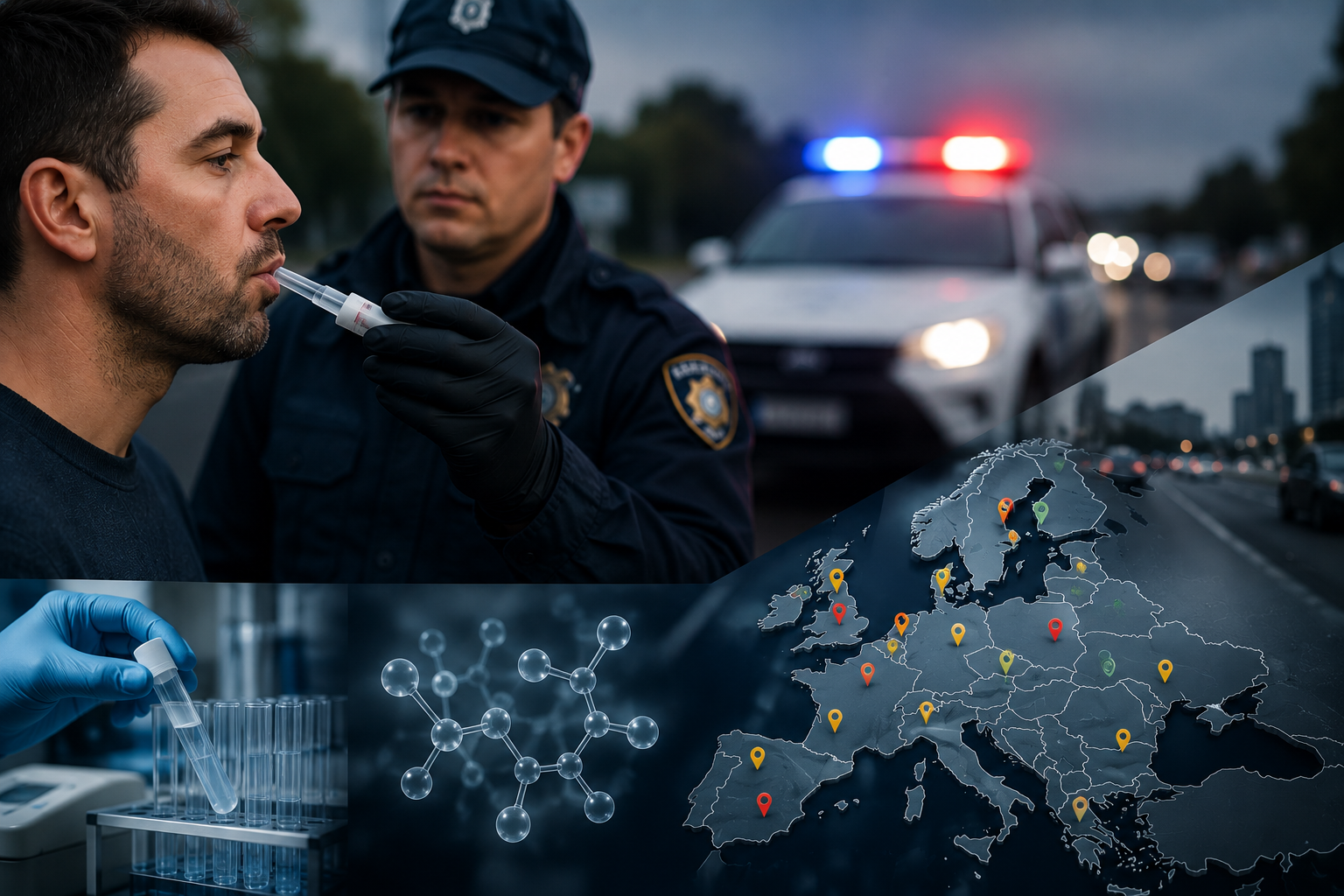
Recent Drug Use vs. Residual Traces: What Quantitative Saliva Testing Can Tell Us
A roadside drug test turns positive. What does that actually mean?
It may mean that a driver used a drug recently. It may indicate a concentration that justifies further action. But depending on the substance, the testing method and the law of the country, it may also reflect a low residual level that says far less about the driver’s condition at that moment.
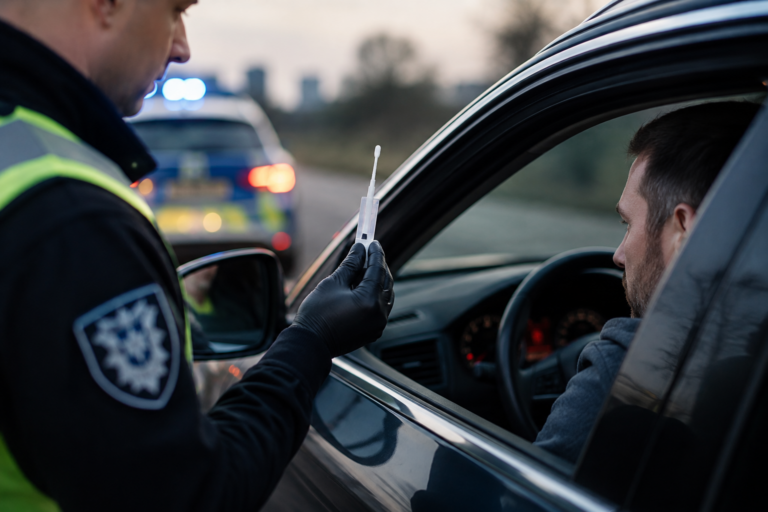
This distinction is becoming increasingly important as oral-fluid testing expands across Europe. One recent market analysis estimates that European authorities, employers and healthcare organisations conducted approximately 18 million oral-fluid drug tests in 2025. On-site testing represented around 94% of that volume, while law enforcement was forecast to be the fastest-growing user segment.
The appeal is obvious. Saliva is relatively easy to collect, difficult to substitute and generally reflects a shorter period of drug exposure than urine. But a shorter detection window is not the same as a perfect clock.
A test can tell us that something was detected. It cannot necessarily tell us, by itself, exactly when it was consumed or whether the person was impaired.
What does a positive saliva drug test actually prove?
Most rapid roadside drug tests are immunoassay screening devices. They are designed to answer a practical first question:
Did the test detect a signal associated with a particular drug class above its own cut-off?
That is useful, but it is not the same as answering:
- Which exact substance was detected?
- What concentration was present?
- Was it consumed recently?
- Does the result exceed the country’s legal limit?
- Was the person’s driving ability impaired?
A binary screening result compresses all this complexity into one word: positive.
That simplification helps police screen large numbers of drivers quickly. It also explains why positive results are generally followed by an evidentiary sample and laboratory analysis. The European Union Drugs Agency notes that nearly all European countries require a confirmatory blood test for prosecution, although the precise procedure varies by jurisdiction.
A positive screening result is the beginning of an interpretation process, not its conclusion.
Why are recent use and residual traces difficult to separate?
Different biological samples describe different periods of exposure.
Urine can remain positive long after the main psychoactive effects have passed because it frequently detects metabolites produced as the body processes a substance. Blood is used in many legal systems because it can provide a measured concentration for evidentiary purposes. Oral fluid is attractive for roadside use because it is easier to collect and is generally more closely associated with recent consumption.
The market report provided for this article describes oral fluid as especially useful for detecting recent use, reducing adulteration and supporting immediate roadside and workplace decisions. It also describes a narrower oral-fluid window than urine, while emphasising the continuing role of laboratory confirmation.
Yet “more closely associated with recent use” must not be confused with “proof of impairment”.
The relationship between a drug dose, the concentration found in saliva, the concentration later measured in blood and the person’s actual condition is influenced by:
- the substance;
- the route of administration;
- the time since use;
- frequency of use;
- individual metabolism;
- sample collection;
- the analytical cut-off;
- other drugs or alcohol;
- the applicable national law.
This is especially important for cannabis. THC concentrations can fall rapidly after consumption, but regular users may retain measurable levels after the acute effects have diminished. A highly sensitive test may therefore detect a trace that is scientifically real without establishing that the driver was currently impaired.
Does every European country treat residual traces in the same way?
No. Europe has no single harmonised drug-driving threshold.
Some countries punish the presence of a controlled drug at or above a very low analytical limit. Others set specific per-se blood concentrations. Others require evidence of impairment. Several combine these models.
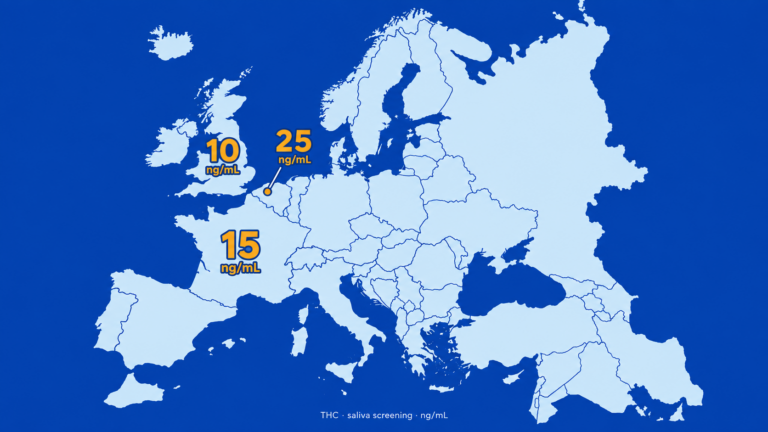
The table below gives illustrative examples, primarily for THC.
These are blood-based legal approaches, not direct oral-fluid cut-offs.
| Country | General approach | THC blood threshold or rule |
|---|---|---|
| Germany | Per-se threshold combined with impairment offences | 3.5 ng/mL in blood serum |
| England and Wales | Low statutory limit intended as a zero-tolerance approach while excluding accidental exposure | 2 µg/L, equivalent to 2 ng/mL in blood |
| Czechia | Per-se limits plus impairment-based offences | 2 ng/mL |
| Denmark | Low per-se threshold plus impairment provisions | 1 ng/mL |
| Belgium | Low per-se threshold for specified substances | 1 ng/mL |
| Spain | Presence-based administrative system; impairment may also constitute a criminal offence | No general numerical threshold; presence in saliva or blood may be sufficient |
| France | Presence-based offence for narcotic substances | No general numerical threshold specified |
| Estonia | Detection/use and impairment provisions | No national numerical blood limit specified |
*Legal note: The table provides a general comparison and is not legal advice. Drug-driving rules, analytical thresholds and evidentiary procedures may change. Operational decisions must follow current national law and validated local protocols.
The EUDA comparison shows just how different the legal philosophies are. Germany now uses a 3.5 ng/mL serum threshold for THC. Czechia uses 2 ng/mL, while Denmark and Belgium use 1 ng/mL. France and Spain largely operate presence-based approaches, while Estonia has no published numerical blood-drug threshold in the EUDA table and combines rules around detected use with impairment offences.
England and Wales set the THC limit at 2 µg/L of blood. The UK government explicitly describes its model for illicit drugs as a “zero tolerance approach”, with limits placed above levels that could plausibly arise through accidental exposure rather than at scientifically proven impairment levels.
Germany has moved in a different direction. Its 3.5 ng/mL THC threshold creates more room between analytical detection and an administrative offence for adult drivers, although stricter rules still apply in situations such as novice driving or combined alcohol and cannabis use.
These are not merely technical differences.
In one country, a measurable trace may be enough to trigger an offence. In another, the same low concentration may fall below the legal threshold. Elsewhere, the decisive question may be whether the driver’s ability was demonstrably impaired.
The instrument detects chemistry.
The law determines what that chemistry means.
Why can a binary roadside test create unnecessary escalation?
Consider the practical sequence after a rapid roadside test returns positive:
- The officer receives a class-level positive result.
- The driver may be taken for an evidentiary blood sample.
- Medical personnel become involved.
- The sample is transported and analysed.
- Police and laboratory time is consumed.
- The final concentration may turn out to be below the applicable threshold.
A Dutch public-sector challenge cited by SafePAS reports that in approximately 40% of positive pre-selections, the subsequent analysis did not find a substance above the relevant legal threshold. The result was substantial use of police, medical and laboratory capacity without prosecution.
This does not mean the original test necessarily “invented” a substance. Several outcomes are possible:
- the screening test reacted incorrectly;
- the concentration was real but below the legal threshold;
- the substance concentration declined before blood collection;
- the rapid test and confirmatory method measured different targets;
- the screening cut-off did not correspond well to the applicable blood limit.
Calling all these cases “false positives” hides the underlying problem. Sometimes the test is analytically wrong. Sometimes it is analytically right but operationally unhelpful.
What does quantitative saliva testing add?
Quantitative oral-fluid testing adds information between the initial stop and the later laboratory result.
Instead of reporting only that a drug class triggered a test, it can show:
- the specific substance identified;
- its measured concentration in oral fluid;
- whether several selected substances are present;
- whether the result is close to or far above an operational cut-off;
- whether escalation is proportionate under the relevant protocol.
Drug Hunter is designed to identify and quantify selected substances directly from oral fluid in approximately 10–15 minutes. Its purpose is not to replace evidentiary blood testing where the law requires it. It is to give trained professionals a more informative result before they commit additional resources to the case.
That distinction matters.
A measured saliva concentration does not automatically translate into a blood concentration. Nor does it independently prove impairment or establish the exact time of consumption. Those conclusions require validated protocols, country-specific thresholds, professional interpretation and, where required, confirmatory testing.
But quantitative information can still improve preselection.
A binary result says:
Cannabis class: positive.
A substance-specific quantitative result can say:
Δ9-THC was identified in the oral-fluid sample at a measured concentration.
The second result gives police and laboratories more data to apply the correct national protocol. It also helps distinguish THC from other cannabinoids rather than treating every cannabinoid-related signal as equivalent.
Can saliva testing determine exactly when a drug was used?
Not precisely.
No single saliva concentration can function as a universal timestamp. Drug concentrations do not decline at an identical rate in every person, and the relationship between oral fluid and blood varies by substance and collection conditions.
Quantitative testing can, however, support a more informed interpretation of whether the result is consistent with recent exposure. It is strongest when used alongside:
- validated substance-specific cut-offs;
- the time of sample collection;
- observed behaviour;
- medical information;
- country-specific law;
- confirmatory analysis where needed.
The responsible message is therefore not:
“This device proves exactly when the person used the drug.”
It is:
“This device provides substance-specific concentration data that helps professionals make a better-informed decision about what should happen next.”
Why will this question become more important?
Europe is conducting increasing numbers of oral-fluid tests. The supplied market analysis forecasts growth from approximately 18 million tests in 2025 to 21.1 million by 2030, driven by roadside enforcement, workplace safety and demand for non-invasive point-of-care testing. It also projects roadside law-enforcement testing to grow faster than other major end-user segments.
As testing volumes rise, even a modest proportion of unclear or unnecessary escalations creates a significant burden.
More tests mean more drivers screened.
More positive screens mean more evidentiary samples.
More evidentiary samples mean more demand on police, healthcare staff and laboratories.
The solution is not to abandon rapid testing. It is to make the information available at the roadside more useful.
Presence is one data point.
Substance, concentration, timing and legal context complete the picture.
What should law-enforcement teams take from this?
Oral-fluid testing is valuable precisely because it brings drug screening closer to the point of decision.
But the next development in roadside testing should not be limited to producing the same yes/no result slightly faster. The more consequential improvement is moving from class-level preselection toward substance-specific, quantitative information.
That will not make every European law identical. It will not eliminate the role of laboratories. It will not turn a chemical analyser into a judge of impairment.
It can, however, help police distinguish a meaningful case from an uncertain one earlier — reducing unnecessary procedures while ensuring that cases requiring escalation receive the attention they deserve.
FAQ
Does a positive saliva drug test prove impairment?
No. It indicates that the test detected its target above the device’s cut-off. Impairment is a separate medical and legal question.
Can drugs remain detectable after their effects have passed?
Yes. The relationship varies by substance, sample type, dose and pattern of use. Residual detection is particularly important when interpreting cannabis results.
Is saliva better than urine for detecting recent drug use?
Oral fluid generally has a shorter detection window and is more closely associated with recent exposure than urine. It is also easier to observe during collection. It still cannot establish an exact time of consumption by itself.
Does Europe have one legal THC limit?
No. National rules differ substantially. Some countries set numerical blood thresholds, some use low presence-based limits, and others focus on impairment.
Can Drug Hunter replace a confirmatory blood test?
No. Drug Hunter supports quantitative on-site preselection. Evidentiary blood or laboratory confirmation remains necessary wherever national law or procedure requires it.
Request a Drug Hunter demonstration
Drug Hunter provides substance-specific, quantitative oral-fluid results to support clearer field decisions.
Contact SafePAS to discuss a demonstration or pilot for roadside testing, workplace safety or professional drug-testing workflows.