Germany After Cannabis Legalisation: Why Roadside Drug Testing Must Move Beyond False Positives
Germany has changed its cannabis laws and introduced a new THC driving limit. But many roadside drug tests still operate like binary screening tools, creating a risk of false-positive preselection, unnecessary blood tests, and wasted police and laboratory capacity. The next step is not just faster testing — it is more informative on-site drug testing.
Germany’s partial cannabis legalisation has changed the legal reality for millions of citizens, but it has also exposed a practical problem for law enforcement: roadside drug testing has not fully caught up with the new rules.
Since 1 April 2024, adults in Germany have been allowed to possess limited amounts of cannabis and cultivate up to three plants for personal use. Since 1 July 2024, non-profit cannabis cultivation associations have also been allowed to operate under defined conditions. In parallel, Germany introduced a new THC driving limit: 3.5 ng/mL of Δ9-THC in blood serum, replacing the previous 1.0 ng/mL threshold that had been in place for more than two decades.
On paper, the change created a clearer legal distinction between cannabis use and punishable drug-impaired driving. In practice, however, many roadside saliva tests still work according to the logic of the old enforcement environment. They are often designed to produce a simple positive or negative screening result, rather than measure whether a driver is actually above the current legal threshold.
That difference matters. A false-positive preselection is not a minor inconvenience. It can trigger a chain of costly and time-consuming procedures: police time, transport to a medical facility, blood sampling, laboratory analysis, administrative processing, licence uncertainty, and legal follow-up. In a significant number of cases, this entire chain may end with no prosecution because the final blood result does not show a substance above the legal limit.
This is the roadside drug testing gap Germany now needs to solve.
What changed in Germany’s cannabis law?
Germany’s Cannabis Act, known as the Cannabisgesetz or CanG, came into force in stages. From 1 April 2024, adults aged 18 and over were allowed to possess up to 25 grams of dried cannabis in public and up to 50 grams at home. Home cultivation of up to three plants also became legal for personal use.
The second stage followed on 1 July 2024, allowing non-profit cannabis cultivation associations, often called cannabis social clubs, to operate under strict rules. These associations may have up to 500 members and distribute cannabis within defined daily and monthly limits. Consumption inside the clubs is not permitted, and restrictions remain in place around schools, kindergartens, playgrounds, sports facilities, and certain public areas.
The legalisation framework has already had measurable effects. Drug-related crime fell sharply after the change, and approximately 100,000 criminal proceedings were avoided in the first year following partial legalisation. Cannabis imports also increased significantly, reflecting a shift toward regulated medical and legal channels.
At the same time, available early population-level data suggests that cannabis consumption has not dramatically increased in the immediate post-legalisation period. The more important change for law enforcement is not necessarily a sudden surge in cannabis use, but the need to enforce a more nuanced legal framework with testing tools that were not originally built for it.
The THC driving limit changed — but roadside testing did not
Germany did not simply legalise cannabis and leave road safety untouched. The government also updated the THC threshold for drivers.
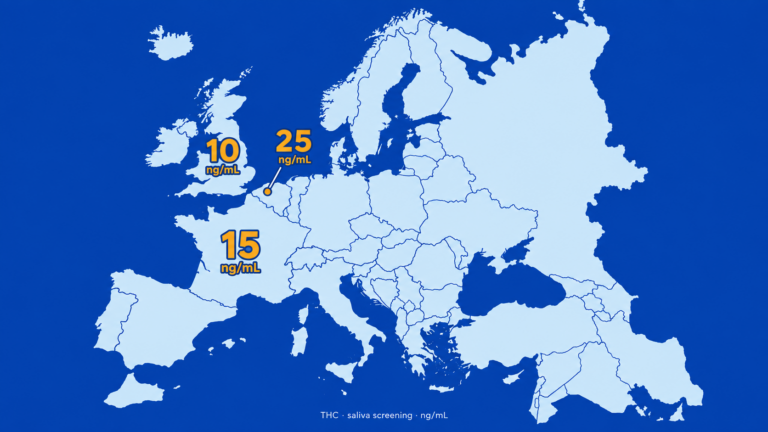
On 22 August 2024, Germany introduced a new driving limit of 3.5 ng/mL of Δ9-THC in blood serum. This replaced the old 1.0 ng/mL threshold, which had been used since 2002. The new threshold was introduced after expert review and was intended to better reflect the difference between detectable cannabis use and legally relevant impairment risk.
The penalties remain serious. A first offence above the THC limit can mean a fine, penalty points, and a temporary driving ban. Repeat offences can lead to higher fines, longer bans, and possible referral to a medical-psychological assessment. Drivers under 21 and novice drivers remain subject to stricter rules, and combined alcohol and THC use is treated more severely.
In other words, Germany has not relaxed enforcement around drug-impaired driving. It has made the enforcement task more precise. Police now need to distinguish more accurately between a driver who has used cannabis at some point and a driver who is above the legal threshold.
That is where the problem begins.
Why false-positive preselection is now a serious operational issue
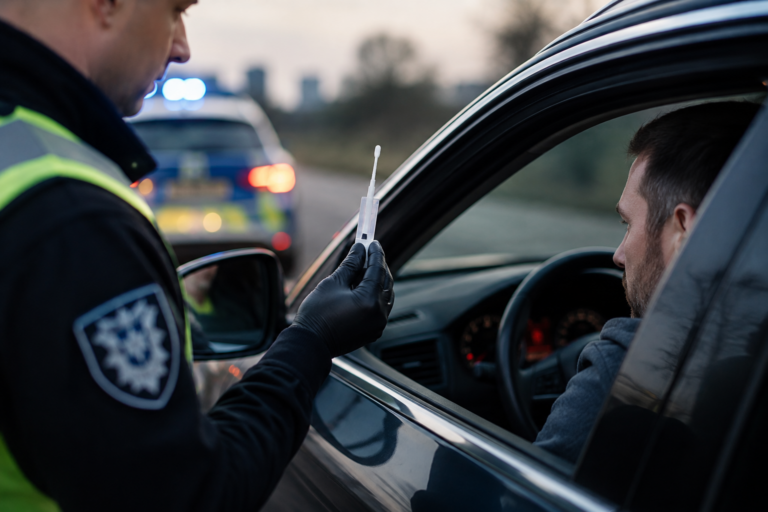
Many rapid roadside saliva tests are immunoassay-based screening tools. They are designed to answer a simple question: is there a signal that suggests a drug class may be present? They are not primarily designed to provide a clear, quantitative answer about whether a driver is above a specific legal threshold.
Before Germany changed the THC driving limit, this was already an imperfect system. After the new 3.5 ng/mL threshold, the mismatch became much more visible. If a roadside test is calibrated around older or lower cut-off assumptions, it may still trigger a positive result in cases where the driver is not above the current legal limit.
The practical consequences are significant. A positive roadside preselection can lead to a blood draw, which usually requires medical staff. The blood sample must then be sent for laboratory analysis, and the final result may take time. During this period, the driver may face uncertainty, administrative consequences, and possible restrictions, even if the final result later shows no exceedance of the legal threshold.
For police forces, the cost is also real. Officer time is spent on cases that may not lead anywhere. Medical and laboratory capacity is used unnecessarily. Administrative systems process cases that may later collapse. Courts and legal teams may be pulled into disputes that could have been avoided if better information had been available earlier.
This is not only a cannabis problem. The same operational logic applies across drug categories: when a preliminary screening result is not specific enough, authorities risk escalating cases that later fail to meet the legal or evidential threshold.
The problem is not just THC — it is the limits of binary testing
Cannabis makes the issue easier to see because Germany has introduced a clear new THC threshold and because THC can remain detectable after the period of impairment has passed. But the broader challenge is bigger than cannabis.
Modern drug use is increasingly complex. Authorities now face semi-synthetic cannabinoids, mixed substance use, stimulants, opioids, and multidrug cases. A simple positive or negative result may no longer provide enough information for fair and efficient decision-making.
A binary roadside test can suggest that a substance class may be present, but it may not answer the operational questions that matter most:
Which substance was detected?
At what concentration?
Are multiple substances present?
Does the result justify further escalation?
Could the screening result later fail to support prosecution?
When a system cannot answer these questions early, false-positive preselection becomes more likely. That creates unnecessary blood tests, avoidable workload, and a higher risk of false accusations.
What Germany needs from the next generation of roadside drug testing
The next step in roadside drug testing is not simply to make yes/no tests faster. The real need is more informative on-site testing.
German police forces and other enforcement agencies need tools that can identify and quantify specific substances from saliva, close to the point of decision. Instead of only flagging a broad drug class, a roadside system should help teams understand what was actually detected and whether the case should move forward.
This is especially important in a legal environment where thresholds matter. If the legal limit is 3.5 ng/mL of Δ9-THC in blood serum, then enforcement needs testing technology that can support threshold-based decision-making rather than simply produce a positive result at a lower or unclear screening cut-off.
For cannabinoids, this also means distinguishing between Δ9-THC, CBD, HHC, and other related compounds where relevant. For broader drug testing, it means identifying and quantifying commonly encountered substances such as stimulants, opioids, and multidrug combinations.
The goal is not to replace every legally required confirmation process in every jurisdiction. The goal is to reduce unnecessary escalation by giving police and safety teams clearer information before the most expensive and intrusive steps begin.
Why false positives are more than a technical problem
False positives are often discussed as a testing-performance issue. But for law enforcement, drivers, laboratories, and public trust, they are much more than that.
A false-positive preselection can create real consequences for an individual driver. Even if the final blood test later shows no substance above the legal threshold, the person may already have lost time, mobility, confidence, and in some cases money. They may have been treated as a suspect in a process that ultimately did not support enforcement action.
For police, false positives create a capacity problem. Every unnecessary case requires attention that could have been directed toward actual high-risk drivers. Officers spend time transporting, documenting, waiting, and processing. Laboratories receive samples that may not have needed to be escalated. Administrative systems become burdened with cases that do not lead to prosecution.
For the legal system, false positives create friction. When drivers contest cases where a rapid test triggered positive but later blood analysis falls below the threshold, the credibility of the whole roadside testing process is weakened.
That is why reducing false-positive preselection should be treated as a public safety priority, not just a technical improvement.
Where Drug Hunter fits into this gap
Drug Hunter by SafePAS was developed to address the limitations of simple roadside screening. It is a portable saliva drug analyzer designed to identify and quantify drug substances on site, helping teams move from unclear preselection toward substance-specific information earlier in the process.
Instead of relying only on a broad positive/negative signal, Drug Hunter provides more detailed analytical information: which substance was detected, at what concentration, and whether multiple substances are present in the same sample. This helps law enforcement, border control, workplace safety teams, and other users make better decisions before unnecessary escalation begins.
For Germany, the relevance is clear. The legal framework now depends on a more precise distinction between lawful cannabis use and punishable drug-impaired driving. A roadside test that cannot reflect that distinction risks generating false-positive preselection and unnecessary follow-up procedures.
Drug Hunter supports a different approach: on-site saliva analysis that helps reduce false positives, supports threshold-aware decision-making, and gives teams clearer information before blood testing and laboratory confirmation are triggered.
A better testing model for the post-legalisation era
Germany’s cannabis legalisation has created a new enforcement reality. Possession and personal use are no longer treated in the same way as before, but road safety enforcement remains strict. This means police need tools that match the law as it exists now, not the enforcement assumptions of the past.
The first year after legalisation suggests that Germany has reduced cannabis-related criminal proceedings without seeing an immediate dramatic increase in use. But the road safety question remains unresolved: how can authorities enforce the new THC driving limit fairly, efficiently, and without unnecessary false-positive preselection?
The answer is not more screening for the sake of screening. It is better information earlier in the process.
Roadside drug testing must evolve from binary indication toward quantitative, substance-specific saliva analysis. This shift can help reduce unnecessary blood tests, protect police and laboratory capacity, improve proportionality, and avoid false accusations against drivers who are not above the legal threshold.
The next 24 months will matter
Germany’s testing gap is unlikely to stay a niche issue. As cannabis use becomes more legally normalised and as medical cannabis access grows, more drivers will fall into the category of lawful users who may test positive on sensitive screening tools but are not necessarily above the legal threshold.
This will create pressure on police forces, laboratories, policymakers, and courts. Pilot programmes for alternative roadside testing technologies are already becoming more important, and procurement decisions made in the next two years may define how Germany handles cannabis-impaired driving enforcement for the rest of the decade.
The countries watching Germany will also learn from this process. Germany’s regulatory direction often influences wider European thinking, especially in neighbouring markets and in countries facing similar questions about cannabis, semi-synthetic cannabinoids, and drug-impaired driving.
For SafePAS, the lesson is simple: modern drug policy requires modern testing. When the law becomes more precise, roadside testing must become more informative. Otherwise, false positives will continue to waste capacity, delay fair outcomes, and weaken trust in enforcement.
Conclusion: fair enforcement needs better on-site data
Germany has updated its cannabis laws. It has updated its THC driving limit. Now the testing infrastructure needs to catch up.
False-positive preselection is costly for everyone involved. It consumes police time, medical capacity, laboratory resources, and legal attention. It can create unnecessary stress and consequences for drivers. And it may ultimately produce no prosecution because the final result does not exceed the legal threshold.
The next generation of roadside drug testing should help prevent that. By identifying and quantifying substances directly from saliva on site, tools such as Drug Hunter can help authorities make clearer decisions earlier, reduce unnecessary blood tests, and support fairer enforcement in a more complex drug landscape.
For German police forces, workplace safety teams, transport operators, and laboratories, the question is no longer whether roadside drug testing is needed. The question is whether the test provides enough information to prevent the wrong cases from moving forward.
That is the gap Drug Hunter was built to close.
About SafePAS and Drug Hunter
SafePAS is an Estonian deep-tech company developing portable analytical systems for real-world decision-making. Its flagship solution, Drug Hunter, is a portable saliva drug analyzer designed to identify and quantify drug substances on site.
Drug Hunter helps law enforcement, border control, workplace safety teams, and other professionals reduce false-positive preselection, avoid unnecessary escalation, and make faster decisions based on clearer saliva-based data.