
Drug Use Trends in 2026: Why Modern Drug Detection Must Evolve
The global drug landscape is changing faster than many monitoring systems can follow. Across Europe, the United States, and Australia, public health agencies and law enforcement are facing a market that is becoming more synthetic, more potent, and far more unpredictable than even a decade ago. Traditional distinctions between “street drugs” and pharmaceutical substances are increasingly blurred, while the rise of polysubstance use is creating entirely new risks for both users and first responders.
According to the latest data from the European Union Drugs Agency (EUDA), Europe’s drug market is now defined by a growing diversity of substances, many of them highly potent and chemically modified. Synthetic stimulants, nitazene opioids, synthetic cannabinoids and mixed drug formulations are appearing more rapidly than authorities can classify or regulate them.
Cannabis remains the most widely used illicit substance globally, but it is no longer the only story. The more important shift is structural: modern drug use is increasingly driven by synthetic chemistry and rapid market adaptation. New compounds emerge specifically to bypass legislation, avoid traditional detection methods, or imitate existing drugs while delivering stronger effects at lower production cost. This creates an environment where both consumers and authorities often do not fully know what substances are actually being used.
A Drug Market Defined by Complexity
In the United States, the opioid crisis continues to evolve around fentanyl and increasingly powerful synthetic opioids. In Europe, synthetic cathinones and methamphetamine are becoming more available, while cocaine purity and seizure volumes continue to rise. Australia remains one of the countries most affected by methamphetamine use, particularly crystal methamphetamine.
Despite regional differences, the direction is remarkably similar everywhere: drug markets are becoming more synthetic, more adaptable, and more difficult to interpret.
One of the clearest trends identified by EUDA is the rise of new psychoactive substances (NPS). The agency reports that dozens of new compounds continue to enter European markets every year, including highly potent nitazenes and synthetic cannabinoids. These substances often appear in counterfeit pills, mixed powders, or adulterated products that users may incorrectly believe are conventional drugs.
This creates a serious problem for frontline detection systems. Many current roadside or field drug tests were designed around a much simpler reality — one where authorities primarily needed to identify a small number of classical drugs such as THC, cocaine, amphetamine, or heroin. That model increasingly no longer reflects what is actually happening in the field.
Polysubstance Use Is Becoming the Norm
Perhaps the most important shift in modern drug consumption is the rise of polysubstance use.
Increasingly, drugs are not consumed individually. Users combine stimulants with depressants, synthetic opioids with benzodiazepines, cannabis with synthetic cannabinoids, or unknowingly consume mixtures hidden inside counterfeit products. EUDA now explicitly describes polysubstance use as a growing concern across Europe, especially in overdose and poisoning cases.
This trend dramatically increases unpredictability. Different substances interact in ways that can amplify toxicity, alter behavioural effects, or increase overdose risk. For medical personnel and law enforcement officers, identifying only one substance may no longer provide enough information to understand what is actually happening.
Traditional screening systems struggle in this environment because many of them operate as binary tests: they answer “yes” or “no” to the presence of a limited number of substances. But modern drug use requires much deeper analytical understanding.
Authorities increasingly need answers to more complex questions:
- What exact substances are present?
- Are multiple drugs involved?
- Is this a newly emerging compound?
- Does the detected substance explain the observed impairment or medical condition?
Without these answers, decisions remain partially blind.
Stronger Drugs, Faster Market Evolution
At the same time, drug potency continues to increase.
The average THC concentration in cannabis products has risen significantly over the last two decades. Synthetic opioids such as nitazenes can be active at extremely small doses yet carry very high overdose risk. EUDA reports growing concern around these compounds, particularly in Baltic and Northern European countries.
Synthetic stimulants are evolving as well. Europe has seen unprecedented seizures of synthetic cathinones and increasing industrial-scale production capacity. The challenge is no longer only about the volume of drugs entering the market, but about the speed at which entirely new variants appear.
By the time trends become visible in annual reports, the market itself may already have changed.
Wastewater monitoring systems help authorities understand broad consumption patterns, but they cannot explain individual cases or provide immediate operational intelligence. Real-world decision-making often happens at the roadside, at borders, in emergency rooms, or during active investigations — environments where waiting for laboratory confirmation may take too long.
Why Drug Detection Must Evolve
Modern drug detection can no longer rely only on classical screening logic.
The future of detection requires technologies capable of identifying a broader spectrum of compounds, distinguishing between multiple substances simultaneously, and adapting rapidly as new drugs emerge. It also requires mobility: analytical capabilities must increasingly move closer to the point of need rather than existing only inside centralized laboratories.
This is where next-generation systems such as Drug Hunter become increasingly relevant.
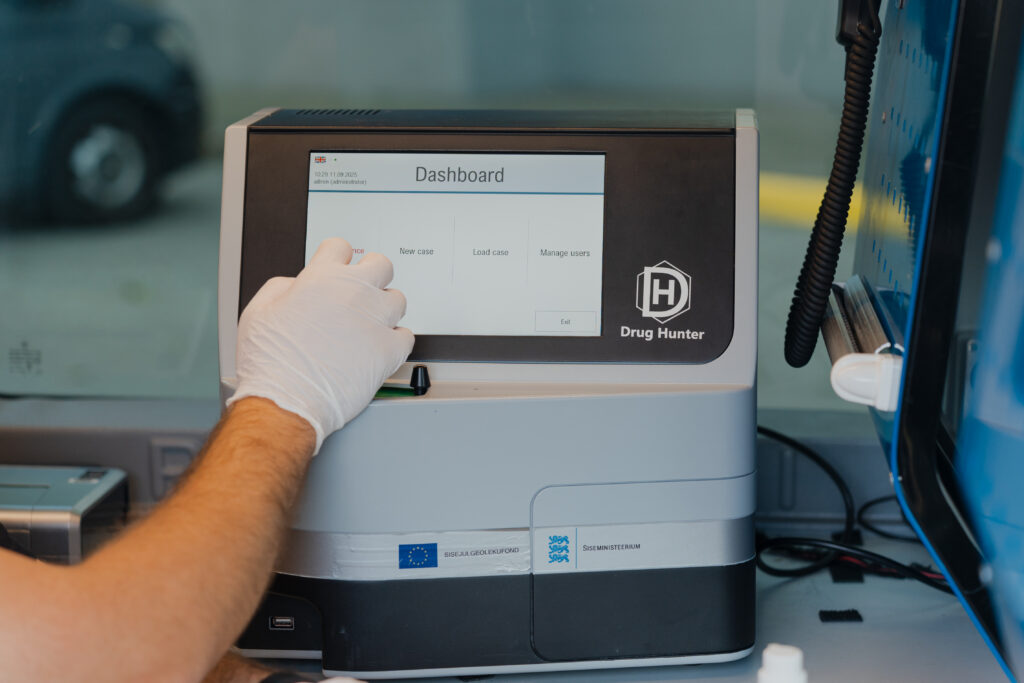
Drug Hunter was designed for the realities of today’s drug environment — not the assumptions of the past. Rather than operating as a simple binary screening tool, it enables rapid on-site identification of multiple substances directly from saliva samples. This allows officers and specialists to gain significantly more detailed information in real operational settings.
In an environment increasingly shaped by synthetic compounds and mixed drug use, this matters enormously.
A modern analytical platform must be capable of:
- identifying specific substances rather than broad drug classes,
- detecting combinations of drugs,
- supporting rapid decision-making in the field,
- and adapting quickly as new compounds emerge.
As semi-synthetic cannabinoids, nitazenes, and synthetic stimulants continue to evolve, the ability to rapidly expand detection capabilities will become critical for both public safety and public health.
The Next Phase of Drug Monitoring
The global drug market is unlikely to become simpler. All available evidence suggests the opposite.
EUDA’s latest assessments describe a market that is resilient, innovative, and increasingly shaped by synthetic chemistry and geopolitical adaptation. The challenge for authorities is no longer only detecting whether “a drug” is present. The challenge is understanding which substances are present, how they interact, and what risks they create in real time.
That requires a new generation of detection technologies.
Drug Hunter represents part of that transition — bringing laboratory-informed analytical capability closer to operational environments where rapid, accurate information can directly influence outcomes. In a world where substances evolve faster than regulations and where mixtures increasingly replace single-drug use, modern detection systems must evolve just as quickly.